One danger facing the spiritual aspirant is the surrender of conscious control. Within an esoteric interpretation, drugs and intoxicating substances can become one means through which that control is weakened. This may include illegal drugs, the misuse of prescription medication, or excessive dependence upon substances such as alcohol and nicotine.
This is not to suggest that properly prescribed medicines are spiritually harmful. Their purpose is often necessary and beneficial. The concern here is with intoxication, dependency, and the deliberate alteration of consciousness when these diminish judgment and self-awareness.
Prolonged intoxication can interfere with the clarity of the mental processes. Metaphysically, it may be compared to a gatekeeper on the lower mental plane lowering his guard, allowing unwanted thoughts, impressions, or astral influences to enter without the individual recognizing their source.
The dark forces, in this symbolic sense, seek weakness wherever it appears. The more developed the individual—the more intelligent, capable, healthy, or influential the personality—the more valuable that person’s energy may become if it can be redirected toward destructive ends.
Some spiritual movements have used intoxicants or mind-altering substances in the belief that temporarily subduing the ordinary mind can open consciousness to another reality. Such experiences may indeed feel extraordinary and even life-changing because the personality encounters states outside its familiar range.
But a momentary opening is not the same as spiritual development.
A safer and more enduring path is meditation, through which an individual gradually establishes a conscious relationship with the soul while remaining awake, aware, and responsible for the process. In this way, the Higher Self becomes the gatekeeper. The individual learns to distinguish between emotional impressions, fantasies, desires, and the quieter guidance that comes through disciplined spiritual practice.
Within esoteric teaching, meditation ultimately seeks to move consciousness beyond the turbulence of the astral plane toward the Buddhic or intuitive realms, where spiritual understanding is clearer and less distorted by desire.
The danger of deception should not be underestimated. Sincere aspirants may sometimes place their trust in teachers, gurus, movements, or groups simply because those sources offer fragments of genuine wisdom. A teaching may contain enough truth to make everything surrounding it seem trustworthy.
Like the serpent offering the forbidden fruit, deception is most effective when what is offered appears attractive.
A few familiar truths may open the door to ideas that would otherwise be questioned. Titles, credentials, popularity, testimonials, or the approval of respected public figures can also encourage people to suspend their own discernment. The spiritual student should therefore never surrender independent judgment merely because an idea is presented by someone considered authoritative.
Under intoxication, the mind—the conscious bridge between soul and personality—may temporarily lose some of its ability to observe and discriminate. In this altered condition, ideas and impressions may seem unusually profound simply because ordinary critical awareness has been reduced.
From an esoteric perspective, this is precisely when the aspirant should be most cautious.
An impression from the astral plane may borrow language from genuine wisdom teachings and thereby appear spiritual. A fragment of truth can become the bait that convinces the student that the entire message is trustworthy.
This is why discernment is so important.
The danger of cults operates in much the same way. Control seldom begins with obvious coercion. It begins gradually—with trust, belonging, admiration, repetition, and the surrender of small decisions. Over time, the individual may become dependent upon the group or teacher for interpretation, approval, and direction.
The problem is not devotion itself, but the abandonment of consciousness.
The goal of genuine spiritual teaching should be exactly the opposite. It should strengthen the student’s ability to think, discriminate, meditate, and eventually stand independently upon the Path.
Whether one describes destructive influences as the dark brotherhood, astral entities, psychological manipulation, addiction, or simply the lower tendencies of human nature, the safeguard remains much the same: clarity of mind, disciplined meditation, personal responsibility, and discrimination.
Darkness thrives where consciousness is surrendered.
It diminishes wherever light is consciously cultivated.
The spiritual path does not ask us to escape the mind.
The concept of the miasm has been used in several older medical, homeopathic, and esoteric traditions to describe a deep underlying tendency toward disease. The word itself originally referred to a noxious influence or unhealthy emanation. Metaphysically, however, the term can be used more broadly to suggest inherited patterns carried through humanity and the planetary life.
From this esoteric perspective, miasms may be regarded as residues of ancient human experience—patterns that remain latent until circumstances bring them into expression. They may appear through inherited physical tendencies, family patterns, environment, or the interaction of physical, emotional, and mental conditions.
This interpretation should not be confused with modern medical explanations of disease. Medicine recognizes many different causes of illness, including infection, genetics, environmental exposure, immune dysfunction, lifestyle, and other biological factors. The esoteric model approaches illness from another level, asking whether patterns of consciousness and energy may also have symbolic significance.
Within certain esoteric teachings, three major miasmic patterns have been associated symbolically with three fundamental expressions of energy.
The Syphilitic Miasm
The syphilitic miasm has traditionally been associated with destructive or ulcerative processes and, metaphysically, with the misuse of creative and sexual energy.
In terms of the Seven Rays, this pattern may be related symbolically to Third Ray energy—the ray of active intelligence, creativity, and the organization of substance. When creative energy is distorted or misdirected, its constructive function may become destructive.
This interpretation is symbolic. Syphilis itself is an infectious disease with a known biological cause, and other sexually transmitted diseases have their own distinct medical causes.
The Tubercular Miasm
The tubercular pattern has been described esoterically as congestive—a condition in which energy is held, accumulated, or unable to circulate freely.
Metaphysically, it may be associated with Second Ray energy, the energy of Love-Wisdom, and with excessive attachment to material life or the inability to release what has been accumulated.
Older esoteric writings sometimes placed a wide range of conditions beneath this category, including asthma, eczema, allergies, sinus problems, migraine, digestive disturbances, diabetes, blood disorders, and psychological or developmental conditions. Modern medicine does not regard these illnesses as forms of tuberculosis or as having a single underlying cause. Their inclusion here therefore belongs specifically to the historical esoteric model rather than to contemporary diagnosis.
The Cancer Miasm
Cancer presents perhaps the strongest symbolic image of overstimulation. Within the esoteric interpretation, it can be associated with First Ray energy, or will.
The will-to-live is normally a constructive force. In cancer, however, cells reproduce without normal regulation and eventually threaten the organism of which they are a part. Metaphysically, this provides a striking image of will separated from the larger whole: life asserting itself without balance or cooperation.
Some older esoteric teachings have also associated tumors and abnormal growth with blocked or distorted energies of the sacral center. Such associations are symbolic and should not be understood as medical explanations for cancer.
MIASMIC PATTERNS
Miasm
Symbolic Form
Esoteric Interpretation
Syphilitic
Destructive or ulcerative
Misuse or distortion of creative and sexual energy
Tubercular
Congestive
Attachment, accumulation, or restriction of circulating energy
Cancer
Overstimulation and uncontrolled growth
Will or life-force operating without balance
In this metaphysical view, disease can sometimes be contemplated as an imbalance in the distribution, suppression, or overstimulation of energy. The chakra system offers another symbolic map through which such imbalance may be considered.
Yet it is important not to interpret illness as punishment, moral failure, or evidence that a person has thought incorrectly. Physical disease is complex, and suffering should never be blamed upon the individual.
The value of the esoteric interpretation lies elsewhere. It asks us to consider whether illness, in addition to its physical causes, may sometimes reveal something about balance: when to express and when to restrain, when to hold and when to release, and how the many energies of the human being may learn to function together as a whole.
Seen in this way, the miasm becomes not merely an image of inherited disease, but a metaphor for patterns carried forward until consciousness brings them into recognition and transformation.
The labyrinth is a spiraling path that winds toward the center of a circular form. It should not be confused with a maze, whose paths lead to choices, conflicts, and dead ends. A labyrinth offers a single continuous path. However far it seems to wander, it ultimately leads to the center.
Used contemplatively, the labyrinth can become a tool of inner transformation. Consciousness is focused upon the path being traveled, upon the “now,” while remaining aware of the center. One walks slowly and deliberately until the center is finally reached.
There is often a feeling of safety and fulfillment at the center, as though some insight or blessing has been received. Yet the journey does not end there. The pilgrim must return along the same winding path, carrying whatever has been discovered back into the outer world.
A labyrinth is therefore a form of pilgrimage—a journey inward and outward again. Medieval cathedral labyrinths, including the famous labyrinth at Chartres Cathedral, have long been associated with contemplative and devotional practice. For those unable to undertake a physical pilgrimage to a distant sacred place, walking such a path could itself become a symbolic journey toward the sacred.
Before entering a labyrinth, it is helpful to establish an intention. The pilgrimage may be undertaken in search of truth, healing, insight, discovery, reconciliation, or transformation. The intention gives meaning to the journey, but the answer seldom arrives in the way one expects.
The path has its own wisdom.
The spiral can also be compared symbolically with the convolutions of the brain and even with the winding structure of the digestive system—the instinctual “lower brain.” The stomach represents our instinctive and desire nature, while the brain becomes the instrument through which mind may eventually bridge toward the spiritual.
Metaphysically, these two functions can symbolize the long evolutionary journey from instinct through emotion and mind toward higher consciousness.
During the walk, ordinary mental control begins to loosen. The path appears unpredictable. Just when one seems close to the center, it turns away again. The ego cannot easily impose its familiar straight-line logic upon the journey.
In meditation, the mundane world falls away and the inner world becomes more apparent. The ultimate goal is not merely to arrive physically at the center of the labyrinth, but to bring the center to you as you walk along the path.
The labyrinth becomes a key to remembering and reconnecting. It is a road map of the soul as it travels through many experiences and incarnations toward its divine source. As with every pilgrimage, the events encountered along the way may be as important as reaching the destination.
Many people who walk labyrinths report unexpected insights concerning relationships, decisions, life direction, or spiritual purpose. Whether these impressions arise from the higher self, the unconscious, meditation, or the simple quieting of ordinary thought, the labyrinth provides a structure in which they may emerge.
Lauren Artress, whose work helped renew interest in labyrinth walking, has described labyrinths as ancient universal patterns that appear to speak through the collective human psyche. Their origins are not entirely known, and perhaps part of their power lies within that mystery.
Labyrinth and spiral forms appear in many ancient cultures. They are found in carvings, pottery, coins, sacred sites, and ritual designs. Although their meanings differ from culture to culture, the spiral itself is one of humanity’s most persistent archetypal symbols.
It is also one of nature’s forms.
We find spirals in shells, storms, galaxies, plants, and growth patterns. The journey toward and away from a center seems written into the natural world itself.
Throughout history, sacred cities and sacred centers have also been symbolically associated with journeys of winding approach. Troy, Jericho, Jerusalem, and other holy places became destinations not merely on a map but within consciousness.
Certain Indigenous and ancient designs have likewise been interpreted as symbols of Mother Earth, emergence, migration, or the journey of life. Although we should be cautious about assigning the same meaning to symbols from very different cultures, their recurring movement between an outer world and an inner center remains compelling.
Other sacred forms use the center in a similar way. Tibetan mandalas, although not labyrinths to be walked physically, guide consciousness symbolically through ordered layers toward a sacred center. In meditation, the mind itself walks the path.
The spirals and enormous ground designs of ancient Peru also evoke this mysterious relationship between landscape, movement, astronomy, and sacred geometry. Whatever their original purposes, they remind us that ancient peoples often inscribed meaning directly upon the Earth.
The Phaistos Disc of Crete offers another intriguing spiral. Its still-undeciphered symbols proceed inward in a circular sequence, preserving information whose meaning remains uncertain. Whether it recorded language, ritual, administration, or something else entirely, the spiral once again became a vessel for knowledge.
William Blake also envisioned the sacred city and mandala as symbols of an eternal order—the visible world opening into a greater world of vision.
The River Map: Labyrinth of the World Order
Ancient diagrams frequently place a creative principle at the center, from which forces radiate outward into manifestation.
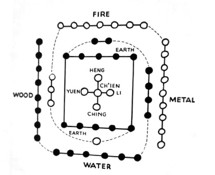
In Chinese cosmological symbolism, heaven may be represented as the source of generative power, while receptive Earth receives and gives form to that energy. Opposing forces—masculine and feminine, active and receptive, heaven and earth—do not remain enemies. They become complementary aspects of creation.
The legendary River Map similarly expresses the idea that number, direction, polarity, and cosmic order underlie visible existence. Legends surrounding such diagrams describe sages discovering within mysterious signs the hidden laws of the world.
Whether taken historically, symbolically, or metaphysically, the underlying idea is compelling: apparent disorder may conceal an unseen pattern.
The labyrinth expresses much the same principle.
The Labyrinth Process
A labyrinth may contain seven or eleven circuits surrounding the center. The path turns inward, outward, and inward again in a continuous movement.
The Chartres labyrinth contains eleven circuits arranged within a fourfold geometry surrounding its central rosette. The cross within its design can be interpreted in many ways: the meeting of heaven and earth, the reconciliation of opposing forces, and, within Christianity, the symbol of Christ.
Sacred geometry depends upon proportion, number, direction, and pattern. These forms speak to the unconscious through ideas of unity, harmony, cycles, order, and unity within diversity.
Yet the experience of walking the labyrinth is deliberately less orderly than its geometry appears.
The pilgrim enters and initially moves toward the center. Almost immediately, the path turns away.
The center can be seen.
Then it disappears.
The traveler moves around one quadrant, across another, back and forth like a pendulum. Just when the goal appears near, the path carries the walker outward again.
This strange movement begins to resemble life itself.
Are we part of a cosmic clock? Do our lives follow patterns and cycles? Who travels beside us? Some people move in the same direction, while others are returning and pass us on the path.
How do we respond?
Are we impatient because someone is moving too slowly? Do we resent another person who appears closer to the center? Are we solemn, joyous, distracted, fearful, or peaceful?
Gradually, the journey penetrates the ego’s defenses.
Small revelations occur.
The walk becomes a physical metaphor for healing, emotional growth, spiritual development, and transformation.
A person may enter the labyrinth contemplating an entire life or only one part of it:
a relationship,
a marriage,
financial concerns,
a loss,
a change of work,
death and rebirth,
or an initiatory journey.
But the labyrinth does not provide a simple answer.
It provides a path.
Cosmology, Mythology, and the Cretan Bull
The labyrinth is most famously associated with the Greek myth of King Minos, the Minotaur, Ariadne, and Theseus.
According to the myth, Daedalus designed a labyrinth to contain the Minotaur, the half-human, half-bull creature hidden at its center. It was both temple and prison—a place so intricate that escape seemed impossible.
Theseus entered the labyrinth to confront the Minotaur. Ariadne gave him a thread, which he fastened at the entrance and unwound as he traveled inward. After confronting the creature, he followed the thread outward again.
Metaphysically, the story becomes far more than the killing of a monster.
The Minotaur may represent man’s lower nature—instinct, desire, fear, and those forces hidden within the unconscious. The labyrinth becomes the journey inward to confront what has been imprisoned there.
Ariadne’s thread is consciousness.
It preserves our connection to the source while we enter the darkness.
We descend inward, confront what must be faced, and then retrace the path toward the light.
This is why the labyrinth remains such a powerful symbol of evolution and initiation. The journey does not ask us to avoid the darkness at the center of ourselves. It asks us to enter consciously, carrying a thread that will lead us home.
The center, then, is not merely a destination.
It is a meeting place between what we have been and what we may become.
And when we finally leave the labyrinth, we discover that the sacred center was never confined to the pattern beneath our feet.
Is the United States guided by the will of the people, through the democracy and republic envisioned by the Founding Fathers, or is it subjected to forces beyond their control?
The Illuminati may be understood not simply as a particular organization, but as a collective force created whenever wealth, influence, selfish ambition, and the desire for power are concentrated in the hands of those who seek control over others.
Human beings are particularly susceptible to persuasion through their emotions. Fear, anger, prejudice, insecurity, and the desire to belong can all become instruments of influence. In this sense, mind control need not involve mysterious technologies. It can occur whenever people surrender independent judgment and allow emotion to replace discernment.
If a nation were governed entirely by objectivity, goodwill, and wisdom, there would be far less opportunity for destructive forces to influence it. But wisdom is earned, and humanity is still young. Everything that man can imagine—both good and evil—can be expressed through those who acquire wealth, influence, and power.
When selfish desires are repeated and strengthened collectively, they can take on an almost independent life of their own. Metaphysically, such accumulated thought and intention may become an entity. It is in this broader sense that I use the word Illuminati: a concentration of destructive thought, greed, manipulation, and the desire to dominate.
The danger is not merely an organization hidden somewhere behind closed doors. The greater danger lies in the human qualities that continually recreate such concentrations of power.
The ideals established by the original constitutionalists remain another force within the nation. Their principles of individual liberty, responsibility, and resistance to tyranny continue to influence those willing to think independently. Yet information itself has become increasingly difficult to evaluate. What is presented as news may inform, distort, persuade, or mislead, depending upon the source and the bias of both the communicator and the listener.
One must therefore be cautious even with accusations of “fake news.” Every claim should be examined rather than automatically accepted because it confirms what we already believe.
To understand the forces behind events, one must ultimately look within. The heart, when freed from emotional reaction and personal prejudice, becomes a seat of discernment. Wisdom cannot arise from blind acceptance, regardless of whether the authority is political, religious, financial, or social.
The battle between constructive and destructive forces is intensified whenever fear and division replace unity. Communications can become instruments for creating anxiety, hostility, and suspicion. Wealth, prestige, recognition, and influence may tempt politicians, journalists, business leaders, and ordinary citizens alike. No profession or political persuasion is immune to these forces.
At the time this commentary was written, I viewed Donald Trump as a particularly polarizing figure within this struggle. His unusually strong ego, which many regarded as a weakness, could also be interpreted as giving him the ability to withstand criticism, hostility, and pressures that might overwhelm a less forceful personality. Whether one agreed with him politically or not, his presence demonstrated how dramatically a single individual could challenge established institutions and public perception.
But no political leader should become the final object of our faith or judgment. The deeper struggle is within humanity itself.
The Illuminati, understood metaphysically, survive wherever greed overcomes service, fear overwhelms reason, and power becomes more important than goodwill. They lose their influence whenever individuals refuse manipulation, examine information carefully, and act from conscience rather than emotional persuasion.
The real safeguard is therefore not fear of hidden powers.
Gifts from friends are often treasured because of the emotional bond between the giver and the receiver. Gifts are tokens of friendship, promises, and remembrance. A popular spiritual practice is to give up treasured possessions in order to release emotional attachments. Some rituals or ceremonies designed for self-empowerment, consciousness-raising, or spiritual discipline are intended to free the ego from excessive sentimentality. A direct challenge to the emotional body is therefore to voluntarily surrender something valued as a keepsake.
I have participated in many small rituals with spiritual objectives, including ceremonies of gratitude, forgiveness, and letting go. The ritual of gift detachment is intended to loosen the energy of attachment. Participants may be asked to bring a gift that has genuine meaning and then relinquish it. If the object carries no emotional significance—if it was never truly appreciated—it is unsuitable for the ritual. Yard sales are full of such discarded tokens, cluttering homes and collecting dust. These are not the treasures a spiritual teacher would select for ceremonial use.
Such rituals may include reflection, prayer, and purification. Meaningful mementos are sometimes buried or burned as a symbolic gesture of releasing the emotional attachment associated with them. In similar ceremonies, participants may write words such as “anger,” “fear,” or the name of an illness on paper and then burn the paper, allowing the words to disintegrate into ashes.
On the surface, this may seem to cancel negative feelings, behaviors, or ego attachments. But the human instrument cannot release deeply rooted emotions so easily. The ceremony itself is only a reminder of the inner work still required. Its purpose is not simply to destroy an object, but to loosen the ego’s attachment to physical things while preserving gratitude for the relationship or meaning behind the gift.
While small possessions can be discarded, gifts of deeper and more intrinsic value belong to another category. Should such gifts also be surrendered merely for the sake of non-attachment?
Children, for instance, are often called gifts from God. Could anyone simply abandon them in the name of spiritual detachment? Could anyone entirely separate feeling from one’s children? Likewise, talent may be regarded as a gift. Could an artist willingly abandon the passion to create, or a musician cease making music merely to demonstrate non-attachment? If the gift of scientific inquiry could be wrapped and thrown into a bonfire, would destroying it be either possible or desirable?
The greater the value of the gift, the less reasonable such a sacrifice becomes.
Whether the gift is a small porcelain figurine, unexpected wealth, the blessing of children, or the possession of talent, all are part of physical experience. A small gift may acknowledge the bond between two individuals. Yet a gift of talent, knowledge, or parenthood may have a wider purpose.
Children are nurtured, educated, and eventually sent into the world to share their own experiences. Artists, musicians, scientists, inventors, and craftspeople develop their gifts and offer them to the community. Their talents may eventually touch people far beyond their immediate surroundings. These gifts are not meant to be discarded. They are meant to be nurtured and shared.
Gifts offered to the world become part of the collective experience.
Ceremonies of letting go should therefore not be understood as rejection of love, memory, beauty, or meaningful relationships. True non-attachment does not require indifference. Rather, it asks us to release the ego’s possessiveness while preserving the gratitude and love contained within the experience.
The lower sentiments of attachment can then be transformed into the higher expression of love.
The deeper meaning of gift-giving is found in reciprocity—in giving and receiving without possession.
Surrounding and interpenetrating our earthly plane is the etheric world, which interfaces with physical life and form and conducts energy through the larger universe. In esoteric teaching, the astral plane is considered the source of much that is described as spiritual or psychic phenomena. It is the plane of desire, or kama-manas—the realm of ideas, dreams, fantasies, hopes, fears, passions, plotting, intrigue, despair, and all those experiences associated with emotion and desire.
Everything existing in the physical world is said to have its counterpart on the astral plane. Yet some forms may exist there that have never appeared physically. Dreams, fears, fantasies, and images created by human imagination may remain unmanifested, gradually fading away, while others may be strengthened through repeated thought and emotion.
Over long periods of time, collective imagination may contribute to the myths and legends of goblins, ghosts, monsters, and other mysterious inhabitants of the unseen world. Esoteric teachings have often cautioned against dwelling too intensely upon frightening forms because thought itself gives energy to form. In this sense, form follows thought.
Man possesses an astral body during physical incarnation that serves as the vehicle of desire and emotion. Our plans, dreams, hopes, fears, and desires create impressions upon this subtler plane. If they are not continually energized, these forms gradually disintegrate. One can only imagine the countless thought-forms created by humanity throughout history. Fortunately, most people are unable to perceive them directly.
This may help explain why literature, mythology, and film repeatedly produce similar horrific creatures. Whether such beings originate entirely in imagination or whether imagination occasionally perceives something already existing on subtler levels remains an intriguing question.
According to esoteric teaching, both incarnate and discarnate beings may inhabit the astral plane. During sleep, human consciousness temporarily withdraws from ordinary physical awareness. Most people remain unconscious of their astral surroundings, although psychics, adepts, and trained students are said to retain varying degrees of awareness.
A second class of inhabitants consists of those who have recently died. They are believed to retain many of the personality characteristics they possessed during physical life. Thus, death does not instantly transform an unpleasant person into a pleasant one, nor does it suddenly bestow wisdom upon someone who did not possess it before.
Those who have lived kindly and with greater refinement are said to pass more easily into higher astral levels, assisted symbolically or literally by light-bearers, guides, or guardian angels.
To understand these inhabitants more fully, we must consider the process of death itself.
Death need not be feared. It may be imagined as the shedding of the outer layers of an onion, except that the outer shell is the densest and each succeeding layer becomes more rarefied as the center is approached.
Annie Besant described the transition after death as a gradual rearrangement and separation of the different densities of subtle matter. In this esoteric model, the dense physical body is abandoned first, followed eventually by the etheric and astral coverings. Consciousness gradually withdraws through increasingly subtle levels.
The more strongly a person has identified with coarse desires and physical appetites, the more difficult this transition may be. Conversely, refinement of the physical, emotional, and mental nature during life is believed to permit an easier movement toward the subtler worlds.
There is a common fear that the dead remain around us with mysterious supernatural powers. Yet if consciousness survives death, there is little reason to suppose that the individual suddenly possesses powers that were absent during life. The person continues, but under different conditions.
Eventually, according to this teaching, the remaining subtle forms are discarded and consciousness moves into higher realms, where the experiences of the previous incarnation can be assimilated before another earthly life begins.
Those strongly attached to physical desires may remain closer to the earthly atmosphere for a longer period. A person who has been intensely attached to alcohol, possessions, sensual pleasures, or familiar surroundings may continue to experience those desires even though the physical means of satisfying them are gone.
This may also offer an esoteric explanation for certain uncomfortable atmospheres associated with particular places. Intense emotion—fear, violence, grief, hatred, or passion—may leave a strong impression upon the surrounding astral substance.
In the case of a tragic or violent death, the repeated memories of surviving relatives may also strengthen the image of the event. An apparition appearing repeatedly on an anniversary might therefore be interpreted not necessarily as the conscious spirit of the deceased, but as a powerful thought-form continually renewed by memory and emotion.
For an apparition to become perceptible, esoteric teaching suggests that either the form must become sufficiently materialized or the observer must be unusually sensitive to astral impressions. What appears as a “ghost” might therefore represent several different phenomena: the lingering etheric impression of a recently deceased individual, an astral shell, the temporary projection of a living person, or a strongly energized thought-form.
Apparitions reported near the moment of death may have another explanation. A newly departed person, strongly concerned for family or friends, may direct a final thought toward them. Likewise, the intense emotions of those left behind may act like a magnet, drawing attention back toward the familiar earthly environment.
Some spirits may remain attached to family, possessions, or unfinished business and resist moving toward subtler levels. In this view, a family ghost need not be frightening. Its personality would remain much as it was during life. A strong personality would continue to display recognizable characteristics even after leaving physical form.
Séances and mediumistic phenomena have traditionally attempted to establish contact with such surviving impressions. Yet caution is appropriate. What communicates through a medium may not necessarily represent the complete consciousness of the deceased. It may instead be an astral shell or thought-form containing memories, habits, and recognizable fragments of personality.
For this reason, intimate knowledge offered during a séance does not necessarily tell us precisely what—or whom—the medium has contacted.
People who die suddenly or violently may, according to esoteric tradition, experience confusion and require assistance in withdrawing from the earthly sphere. Rather than holding them through grief or continually calling them back, it may be more helpful to surround them with thoughts of peace, goodwill, and light.
Perhaps this is one of the most compassionate ways of thinking about ghosts: not as creatures to be feared, but as consciousness—or the lingering impressions of consciousness—still seeking release.
When death comes, the most loving act may be to let the departed go forward.
The media have often been used carelessly—and sometimes deliberately—to target households through aggressive advertising campaigns. At its worst, this becomes a kind of mental poisoning, repeatedly planting suggestions intended to influence judgment and behavior.
Financial institutions campaign relentlessly for new credit-card customers. Homeowners receive offers encouraging them to borrow money for improvements, and insurance companies advertise health-care plans at seemingly irresistible rates. Such promotions are not necessarily dishonest, but their presentation can sometimes be misleading, particularly when important qualifications are buried in fine print.
Much of the confusion begins with promotional material sent through the mail. Unless recipients read carefully, they may be influenced by bold promises while overlooking pages of qualifications and conditions.
The bold type is the carrot.
Offers may arrive as checks, official-looking notices, or documents designed to create a sense of urgency. By signing or accepting certain offers, consumers may unintentionally obligate themselves to subscriptions, loans, or services that continue to be charged monthly. Canceling them can then become time-consuming and frustrating.
Some letters are designed to resemble official correspondence or to suggest that the recipient has already requested information. Credit-card solicitations are a common example. Their wording may imply an existing relationship when, in fact, the correspondence is simply an advertisement.
I once received correspondence concerning a long-term-care insurance program. The first letter introduced the program and included a coupon for requesting free information. I had been away for several weeks when it arrived and had never requested the material.
A second letter was more disturbing because its wording gave the impression that an existing membership or wellness plan was about to expire. It warned that unless I acted immediately, I risked losing membership.
Health care is a serious concern, and few people would casually ignore a warning that their coverage was about to end. The wording therefore created a sense of urgency and, at first glance, suggested that I was already enrolled.
I read further.
The letter stated that the company had been unable to bill a credit card supposedly provided by me and that the membership would be canceled unless other payment arrangements were made. An invoice was enclosed.
Yet I had never supplied a credit card and had no recollection of enrolling in such a plan.
Reading carefully, I realized that the wording did not necessarily prove I was already a customer, but it was constructed in a way that could easily lead a hurried or anxious reader to believe so. The first letter had introduced the company and its services; the second created urgency. Whether intentional or not, the sequence demonstrated how suggestion and repetition can influence perception.
In another situation, my elderly mother received repeated telemarketing calls and unwittingly accepted a telephone service she already possessed. For more than six months, she was billed for two local telephone services without understanding why.
The elderly can be particularly vulnerable to persistent telephone solicitation. Memory problems, confusion, loneliness, or simply the pressure of a skilled salesperson can make it difficult to resist. Rehearsed responses to every objection can wear down even an alert person.
Persuasive advertising succeeds partly because it appeals to emotion before reason has time to intervene. Fear, urgency, scarcity, security, status, and the promise of savings are powerful inducements. Repetition gradually makes a name or idea familiar, and familiarity itself can begin to feel trustworthy.
To resist this continuing media blitz, we need to become more conscious consumers. Before responding to mail, telephone calls, e-mails, or advertisements, ask whether the sender is familiar, whether the service was actually requested, and whether there is any genuine need to act immediately.
Read the fine print. Question urgency. Verify the sender independently.
Most importantly, pause long enough to distinguish between a decision you have consciously made and one that has been subtly made for you.
The presence of great and sacred prehistoric monuments has always challenged man’s ideas about his own evolution. Modern man sometimes assumes that we have reached the pinnacle of technology while regarding our distant ancestors as comparatively primitive and unsophisticated. Yet immense structures stand throughout the world, their construction continuing to inspire wonder and debate. On Easter Island, the great stone figures gaze silently across the land, concealing the secrets of their presence.
Archaeologists and engineers have devoted considerable effort to reconstructing the techniques ancient peoples used to carve, transport, and erect these enormous monuments. Ingenious explanations have been proposed, yet the mystery continues to fascinate those who suspect that ancient humanity may have possessed knowledge now forgotten.
Modern evolutionary science traces human beings and the living apes to distant common ancestors. Metaphysically, however, another possibility may be considered: that man’s physical and spiritual history is far more complex than the surviving archaeological record reveals. Human consciousness has evolved through vast cycles of experience, and the sudden flowering of great civilizations—in literature, mathematics, astronomy, architecture, and the arts—continues to provoke questions about the sources of human inspiration.
Civilizations have risen and fallen through cyclic activity. Drought, warfare, migration, environmental change, and political collapse explain much, but perhaps not everything. Again and again, civilizations reach remarkable heights and then disappear, leaving fragments of knowledge behind.
Recorded history represents only a small portion of humanity’s existence. Sacred texts, legends, archaeological discoveries, and the remains of vanished civilizations continually push our awareness farther into the past. Each discovery reminds us how incomplete our understanding of human beginnings remains.
The Bible itself contains an intriguing image. In Genesis, the “sons of God” encounter the “daughters of men,” and the account speaks of giants and “mighty men which were of old, men of renown.” (Genesis 6:2–4)
Imagine, if you will, that this ancient passage preserves the memory of beings whose physical stature and abilities differed greatly from our own. If such beings were extraordinarily large, tasks that seem almost impossible to us—carving enormous monuments, lifting great stones, and constructing vast ceremonial centers—might have presented very different challenges.
The idea is speculative, but the metaphor is compelling. We already know that the forms of life on Earth have changed enormously through time. Great animals once roamed landscapes very different from those we know today. Why should we assume that every chapter of human physical history is already understood?
Within an esoteric interpretation, the ancient stories of gods descending among humanity may represent contact between early peoples and beings possessing greater knowledge. The “God-men” of legend may have been remembered not merely for their physical size, but for the sciences and technologies attributed to them.
Physical strength may not have been the only means by which colossal palaces, roadways, monuments, and ceremonial centers were created. Ancient traditions repeatedly speak of knowledge imparted from gods to men. Transportation, in these accounts, was not necessarily confined to travel upon the ground but extended symbolically—or perhaps literally—to air and water.
Many great ancient sites are associated with oceans, lakes, rivers, or landscapes dramatically altered by geological change. Tiahuanaco stands near Lake Titicaca, while other ancient ceremonial centers preserve memories of water, floods, and vanished lands. Esoteric traditions likewise speak of Lemuria and Atlantis, continents or civilizations overwhelmed during great planetary changes.
From this metaphysical perspective, Easter Island may preserve a memory of such an earlier age.
The great moai rise from the island like ancestral presences. Most were positioned to look inland toward the communities they represented, as though watching over the living. To me, their silent forms suggest beings who have emerged from another time and now stand as guardians of memory.
Could their monumental scale preserve a racial memory of the great beings of an earlier age? Could the ancestors commemorated in stone have carried within their traditions memories of migrations from lands lost beneath the sea?
Perhaps the moai do more than represent individual ancestors. Perhaps they embody humanity’s recurring memory of those who came before—teachers, God-men, or ancestral beings whose knowledge survived only in fragments of legend and stone.
We live today in a world where iron floats upon the seas and levitates through the skies—achievements that would once have appeared magical or impossible. Technologies that seem commonplace to us would have been beyond imagination only a few centuries ago.
Who can say with certainty what knowledge has existed before us, been lost, and later rediscovered?
What we know today may be only a partial inkling of discoveries still to come.
Many crystal skulls have been discovered or brought to public attention in various parts of the world, generating considerable interest in their possible function and historical significance. Some well-known skulls have been examined under laboratory conditions in an effort to determine how they were made, their probable age, and whether they could be associated with ancient cultures.
Certain skulls are remarkably lifelike and have been carved from single pieces of crystal. Their polished surfaces and precise forms have contributed to the mystery surrounding them. There are also many modern crystal skulls produced with contemporary tools, but the symbolism of the skull itself remains significant.
At the British Museum in London, I visited a crystal skull that is on public display. Its form is beautifully shaped, and the natural inclusions and patterns within the mineral create impressions that resemble cosmic structures and celestial pathways. Every crystal contains its own unique pattern of formation.
Scientists cannot date quartz in the same manner as organic material because crystal does not contain the carbon needed for radiocarbon dating. This adds another layer of uncertainty to the history of individual skulls.
Crystal and stone skulls have also appeared in shamanistic and ceremonial traditions in parts of South America. Crystals themselves have long been associated with healing, energy, and the directing of subtle forces. In some traditions, quartz crystals were regarded as transmitters or reservoirs of spiritual power. Could such practices be remnants of knowledge believed to have been handed down from earlier gods or teachers?
The visible physical universe provides science with matter that can be measured and studied. When the time, place, or purpose of an artifact remains uncertain, however, inference, symbolism, and correlation may become another means of exploring its meaning. For the spiritually inclined, the mystery of the crystal skull may also be approached through intuition.
In considering the symbolism of crystal skulls, several correlations suggest themselves. One concerns the nature of mineral formation; another concerns the spiritual purpose of the mineral kingdom, which may be understood metaphysically as radiation, brilliance, and the gradual refinement of matter.
The diamond may be seen as representing the highest purity of the evolved mineral kingdom, and therefore as a symbol of the inner fire of perfected man. Crystal, too, has qualities of transmission, reception, and precision. Quartz is used in electronic devices because of its stable physical properties, and silicon derived from minerals has become fundamental to computers and communications technology.
Metaphysically, this capacity to receive, hold, and transmit information becomes a powerful symbol of consciousness itself.
Perfected man uses his highest spiritual faculties to receive illumination and transmit it in service to humanity. Light is reflected and radiated most strongly from that which has undergone refinement. Both diamonds and crystals are formed under great natural pressures, and this becomes an apt metaphor for human spiritual development.
Man, too, may be viewed as evolving from dense matter into progressively more refined states of consciousness: from the mineral kingdom, through the plant kingdom of sensation, the animal kingdom of emotion and instinct, and into the human kingdom of intelligence. Beyond the human lies the Fifth Kingdom, the spiritual Kingdom of the Soul.
Through thousands—perhaps millions—of experiences and incarnations, man is likewise shaped by pressure, conflict, learning, and refinement into a possible luminary of spiritual life.
The crystal skull therefore becomes a symbol of this evolutionary process. Within the skull lie the brain and the pineal and pituitary glands, structures traditionally given considerable significance in esoteric teaching. The head is the primary control center of the physical body. When the head centers—the Crown and Ajna chakras—are brought into relationship with the Heart center, an important stage of spiritual integration is said to occur.
The mind then becomes a bridge through which the soul may increasingly express itself through the physical personality. Illumination increases as consciousness expands.
Light is an important correlation. As spiritual awareness increases, so too does the symbolism of radiance. Just as a spiritually evolved person may be thought to emanate a quality that influences the surrounding environment, rarefied gemstones such as diamonds and crystals radiate brilliance and possess their own distinctive magnetic presence.
Crystal also suggests transparency.
Until spiritual refinement is achieved, the human aura is described as containing many colors and varying degrees of density. As consciousness becomes more spiritual, these colors may be perceived as increasingly refined, translucent, and magnetic. The aspiration toward purity is therefore beautifully expressed in the familiar phrase “crystal clear.”
The crystal skull itself becomes an image of light diffused throughout the human head. In metaphysical teaching, energy and thought are closely related. Alice Bailey and other theosophical writers repeatedly emphasized the principle that “energy follows thought.” Thought directs action, shapes character, and contributes to the gradual building of the personality.
The physical body may therefore be viewed as a temple of indwelling life, its outer form expressing something of the consciousness within.
From this perspective, the crystal skull becomes metaphysically linked with the soul-infused or enlightened human being. A skull sculpted from clear crystal becomes a striking image of inner illumination: the human form transformed into a vessel of light.
The internal grains, fractures, and patterns within the crystal can suggest cosmic regions and starry pathways, as though the heavens themselves had been captured within the substance of the skull.
Whether prehistoric artisans consciously intended such meanings cannot be known with certainty. Yet symbolically, the crystal skull can represent enlightened Beings whose presence has guided humanity through what esoteric traditions describe as a hierarchy of Masters.
The sculpted skull becomes an image of the indwelling light.
As humanity approaches greater spiritual realization—the destination toward which the planetary scheme is believed to move—the opaque personality may gradually become transparent to the Soul. In this sense, the crystal skull offers a compelling metaphor for the crystallization of Christ consciousness: matter refined until it becomes capable of transmitting light.
In the gardens of Coral Castle, visitors are unprepared for the startling stone sculptures made from hard coral rock. Its architect and engineer, Edward Leedskalnin, seemed to defy ordinary expectations of physics as he shaped and moved enormous blocks of stone, leaving behind tantalizing clues that hint at possible metaphysical secrets.
This unusual castle, located near Homestead, Florida, has long been the focus of study and speculation. Leedskalnin, a relatively small man, apparently constructed and moved massive stone monuments largely by himself, without modern machinery or a large labor force. It was the lifetime work of one man who often worked at night, apparently employing his own understanding of gravity, magnetism, leverage, and physical laws. His achievement continues to fascinate engineers as well as metaphysicians who suspect that he may have understood principles not immediately apparent to the casual observer.
Coral Castle consists of high coral-stone walls enclosing approximately an acre. The interior is open and, at first glance, appears to contain an almost random assortment of stone sculptures: rocking chairs, moons, planetary forms, tables and chairs shaped like Florida and a heart, and a grotto associated with the story of the Three Bears. Other configurations include the Repentance Corner, stone beds and bathtubs, obelisks, and structures revealing Leedskalnin’s remarkable interest in astronomy.
I could not escape the impression that certain energy relationships had influenced his choice and arrangement of the site. At particular places, one may even experience the curious sensation of being pulled backward. Whether magnetic, psychological, or something more subtle, the effect adds to the mystery.
An observation post contains a small opening directed toward Polaris. Crossed wires focus the eye toward a nearby obelisk containing another opening near its top. The larger aperture appears to frame the path of Polaris within a circular field. On the north wall is another configuration suggestive of Masonic symbolism: a right angle lying across a rectangular form created by two cubes. Through this wall, Leedskalnin bored an opening aligned toward true north. From an exact position, the observer can again sight Polaris through the angular opening.
On the eastern wall, several coral forms represent Mars, Saturn, a large moon, and a smaller moon. This arrangement is particularly interesting from an occult point of view because these heavenly bodies have long been associated with influences upon human personality.
The Moon may be viewed symbolically as the personality, illuminated by the light of the Sun as the Soul illuminates the lesser self. Mars is traditionally associated with conflict, desire, and the lower nature of man, while Saturn holds a formidable position as the planet of limitation, discipline, and restriction. The Moon itself has long carried occult associations with man’s personality and emotional nature.
Did Leedskalnin deliberately conceal occult knowledge within these planetary sculptures, or was the arrangement merely his homage to the heavens? The question remains open. Yet there is an unmistakable emphasis upon the Moon throughout the garden. Not only are moons carved upon the eastern wall, but beneath two crescent moons placed back to back he constructed a reflecting pool.
In this pool he placed a six-pointed star carved from smooth coral. The six-pointed star appears in other, less obvious locations throughout the castle. It is an ancient symbol that long predates its later religious associations and has been linked with occult wisdom and universal principles. Others have connected the form with Latvia, Leedskalnin’s native country, where similar star imagery has cultural significance.
The star within the reflecting pool is particularly striking because its surface has been deliberately smoothed. In occult symbolism, the six-pointed star may be interpreted as the interlocking of an upward-pointing triangle representing spirit or soul and a downward-pointing triangle representing matter or personality. When the two unite, spirit and matter are reconciled.
Seen in this way, even the polished surface becomes suggestive. Man’s intervention has smoothed the rough edges of the crude coral substance, much as consciousness refines the personality. Placed within a reflecting pool, the star seems to emphasize another idea: that the lower man is but a reflection of his higher self, the Soul.
The Feast of Love table is a whimsical heart-shaped table surrounded by seven chairs. Was it Leedskalnin’s tribute to “Sweet Sixteen,” the young woman who, according to the familiar story of Coral Castle, rejected his proposal of marriage? The tale of Sweet Sixteen has become inseparable from the mythology surrounding the castle.
Was Leedskalnin simply a mechanical genius who surrounded his accomplishments with clues about lost love and a fascination with astronomy, or was he a dedicated seeker attempting to communicate discoveries to a public not yet prepared to understand them?
The Feast of Love table invites another interpretation. Love, in theosophical teaching, is regarded as a central magnetic principle of life. Our planetary system is associated with the Second Ray of Love-Wisdom, from which the seven rays find expression. It is therefore intriguing that seven chairs surround an altar in the shape of a heart.
Two openings in the walls align with the east and south. Their apparent function is directional, and near the intersection of those lines stands the Table of Love. Symbolically, life rises in the East and receives spiritual renewal from the South. Perhaps universal ideas exert their influence upon human consciousness whether men such as Ed Leedskalnin consciously recognize those principles or not.
This is what makes Coral Castle so enigmatic. An occult student can discover correlations with basic theosophical ideas almost everywhere one looks.
There is also a curious and whimsical configuration known as the “Grotto of the Three Bears.” Guides at the castle have said that Ed imagined that Sweet Sixteen might someday become his wife and that children would live there. The Three Bears, according to this interpretation, were intended for their amusement.
Our group held an Aquarian Full Moon meditation in this area following a talk. There was ample space among the rock carvings for twenty or more people to sit. In the center of the surrounding tables and chairs was another stone basin filled with water. It caught the brilliant moonlight like a mirror.
It was an unusually clear night. The Moon shone with such intensity that it seemed to spotlight Leedskalnin’s man-made lunar sculptures. Rising in the east above the planetary arrangement along the castle wall, it transformed the garden into something quite different from its daylight appearance.
Nothing in the park seemed entirely random. Everything appeared to have been placed in a calculated and specific location.
If there were a deeper significance to the “Three Bears,” perhaps the name concealed a reference to the celestial Bears. Such a possibility would surely have amused Ed. The Great Bear, or the Seven Rishis, also appears in the writings of Madame Blavatsky as having a particular relationship to our planetary system. She likewise wrote extensively about the Moon and its continuing occult influence upon human consciousness.
On diagrams of the castle, several oddly shaped chairs and tables surround the Three Bears area. To the metaphysical eye, their arrangement can even suggest the sevenfold pattern of the Great Bear, loosely circling the reflecting pool—the seminal water of life.
Was Ed Leedskalnin an Adept, an eccentric mechanical genius, or simply a man who discovered physical laws that others had overlooked? Whatever the answer, his castle remains filled with correlations that invite further consideration.
Above his sun calendar, which marks the passage of time, he placed a massive stone chair overlooking the park. From this elevated position he faced toward the northeastern corner of the castle walls. Its placement above the calendar seems almost symbolic: man’s consciousness seated above time.
From that central point, Leedskalnin could watch the heavenly bodies travel from east to west across the great vault of the sky. He could observe Polaris, the rising Sun, and the changing seasons. Surrounded by stone representations of planets, moons, stars, and directions, he could contemplate the nature of man, the lesser planetary influences affecting human existence, and perhaps man’s greater relationship with the Divine.