Author: Jeanne Ross

  • The Sacredness of Place

    THE SACREDNESS OF PLACE

    Why do certain places retain a sense of sacredness long after the people who first used them have disappeared? A cave covered with prehistoric paintings, a circle of standing stones, an ancient pathway, a cathedral labyrinth, or even the site of a tragedy may acquire significance that extends beyond the physical objects left behind.

    Perhaps sacredness is not created at one moment but accumulated.

    Human thought and emotion are forms of energy. When generations of people return repeatedly to the same location to pray, mourn, meditate, perform ceremonies, make offerings, or seek communion with something greater than themselves, they concentrate their attention on a particular place. From a metaphysical perspective, repeated thought and intention may impress an energetic pattern upon the environment, just as repetition strengthens other patterns of consciousness.

    The painted caves of prehistoric people may represent an early example. People created images deep within places removed from ordinary life and apparently revisited them over long periods. Whatever their precise purpose, the repeated journey into darkness, the making and viewing of images, and whatever ceremonies accompanied them may have reinforced the cave’s significance. Perhaps the power we experience in such places today comes not only from their antiquity or their images, but from the repeated intentions of the people who once entered them.

    The great Nazca ground inscriptions of Peru remain among the mysteries of the ancient world. Their enormous geometric lines and figures suggest a ritual purpose, possibly involving ceremonial walking or a pilgrimage of sorts, although this has never been conclusively established. Some interpretations associate the lines with astronomical or calendrical observations, while others emphasize water, fertility, ritual pathways, and religious ceremony. Their exact purpose remains unknown.

    Part of their mystery lies in their extraordinary scale. Monkeys, birds, spiders, geometric forms, and other immense symbols were inscribed upon the desert floor, some extending hundreds of feet. Although portions of the designs can be seen from surrounding elevations, their complete forms are most striking from high above—a perspective their creators could never have experienced, as we do from a modern aircraft.

    Whatever their original meaning, the Nazca Lines demonstrate an extraordinary investment of communal effort in creating and repeatedly approaching a particular landscape. If people walked these lines ceremonially, returned to them for rituals, or regarded the figures as connections between the earthly and celestial worlds, the desert itself may gradually have acquired sacred significance.

    The mystery remains. Were these enormous inscriptions astronomical markers, sacred pathways, offerings to supernatural powers, symbols intended for the gods, or some combination of purposes we no longer understand? Their silence is part of their power.

    The labyrinth at Chartres Cathedral provides a particularly evocative example. A person enters the labyrinth, follows its winding course toward the center, and then returns outward. The destination is only a short distance away, yet the path demands a long, deliberate journey. The physical act of walking becomes an inward experience. Each person follows essentially the same pathway as those who walked it before.

    Stonehenge, Avebury, Newgrange, Mount Kailash, Jerusalem, Santiago de Compostela, Mecca, and the ghats of Varanasi show different ways human beings continually return to particular locations. Some were sacred from their beginnings; others acquired additional layers of meaning as generations came, departed, and returned. Pilgrimage itself may be part of what sustains their sacred character. The individual comes and goes, but the place remains.

    And we can observe this process in our own time.

    The World Trade Center site in New York was once primarily a place of commerce. The events of September 11, 2001 transformed it. Since then, millions have visited the site, and every anniversary renews the event in the consciousness of millions more. At the memorial, people stand beside the reflecting pools, touch the names of the dead, leave flowers, pray, remember, and mourn.

    But what is actually being commemorated?

    Is it the destruction of the towers? The nearly three thousand lives lost? The hatred that motivated the attack? The grief of those left behind? The courage of firefighters, police officers, rescue workers, passengers, and ordinary people who attempted to help others? Is it fear, patriotism, anger, sacrifice, compassion, or love?

    Perhaps all these emotions have entered the place’s history.

    This raises a larger question. If repeated human consciousness contributes to the energy of a place, does the nature of that consciousness determine what remains? Sacredness need not mean that everything accumulated there is peaceful. Battlefields, burial grounds, places of execution, and sites of catastrophe may carry an entirely different atmosphere from temples, monasteries, and places of prayer. Grief, fear, anger, courage, sacrifice, compassion, and love may all leave their impressions.

    But commemoration may do something more than preserve the original event. It may gradually transform its meaning.

    At Ground Zero, the public ritual does not reenact the destruction. They read the names of individual human beings. Flowers are placed beside them. People remember stories of courage and sacrifice. Families remember those they loved. Strangers who never knew them stand silently before their names.

    The original act was intended to destroy. The continuing act of remembrance does something very different.

    If human consciousness contributes energy to a place, then each generation has some responsibility for the quality of the energy it continues to give it. Hatred can be remembered and thereby renewed, but so can courage, compassion, sacrifice, forgiveness, and love. A memorial can preserve the horror of an event without perpetuating the hatred that caused it.

    Perhaps this is one purpose of a sacred monument. It does not merely preserve history. It gives succeeding generations a place in which to decide what part of that history they will continue to energize.

    If people return to Ground Zero for centuries, will future generations experience it as we experience an ancient sacred monument today? And if they do, what will have created its sacredness—the violence that occurred there, or the generations of human beings who returned afterward to remember?

    Perhaps both. But what ultimately persists may depend upon what humanity chooses to commemorate.

    Perhaps a place’s sacredness does not reside solely in stone, earth, architecture, or history. Human consciousness may help create it.

    A place remembers because humanity continues to remember there.
  • BEAUTY AND THE SPIRITUAL LIFE

    What is the consequence of living a life surrounded by beauty?

    Beauty is not merely something pleasant to look at. From a spiritual point of view, beauty carries a quality of harmony, order, refinement, and vibration that impresses itself upon consciousness. The environment we create around ourselves can either support these qualities or work against them.

    I value an aesthetic environment because of the effect it has upon my inner life. The external world can often be discordant, chaotic, materialistic, and self-centered. When I return to my home, I want to find some degree of order and beauty—color, fragrance, harmony, and objects that bring a sense of peace and refinement.

    If beauty cannot be found in the home, it can be sought elsewhere: in nature, gardens, museums, architecture, music, and the great works of artists who have left us their vision.

    We are all surrounded by the legacy of creative people. Great works of art, and even lesser works sincerely created, attempt to bring order, beauty, harmony, and aesthetic sensitivity into life. By surrounding ourselves with these qualities, we become more responsive to them.

    This is particularly important for children.

    When children are exposed to beauty early in life, they have the opportunity to become sensitive not only to their physical environment but also to the subtler qualities of harmony and order. The education of a child into the creative life can therefore become part of spiritual education. Sensitivity develops through experience and discernment when the child is given the opportunity.

    But what actually makes beauty spiritual?

    Spirituality does not have to be removed from ordinary human life or confined to celestial realms.

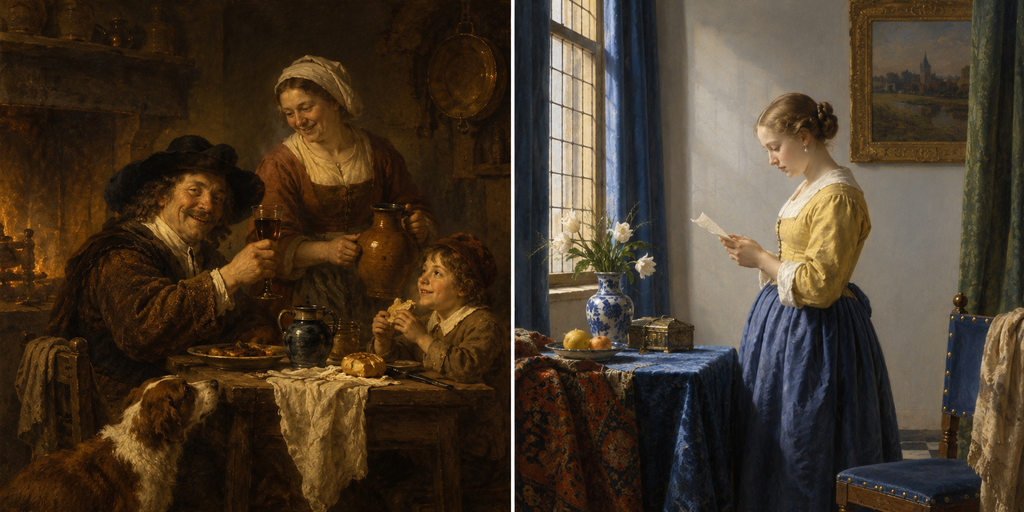
    Consider Rembrandt and Vermeer, who were contemporaries in seventeenth-century Holland. Both found significance in human experience. Rembrandt frequently portrayed profound emotion, compassion, suffering, and dignity in ordinary people. Vermeer transformed quiet domestic interiors into moments of stillness and beauty.

    The subject itself does not have to be religious.

    The spiritual quality may lie in what the artist perceives within the subject.

    Michelangelo’s David is another example. We see the perfection of the youthful human form, but the sculpture conveys something beyond physical anatomy. There is inner strength, dignity, readiness, and integrity. The stone seems to contain the spirit of the human being within it.

    Spiritual things are not always “out of this world.” They can be integrated into this world. Human life can be infused with qualities that transcend mundane interests and give dignity to the Soul.

    Architecture can accomplish the same thing.

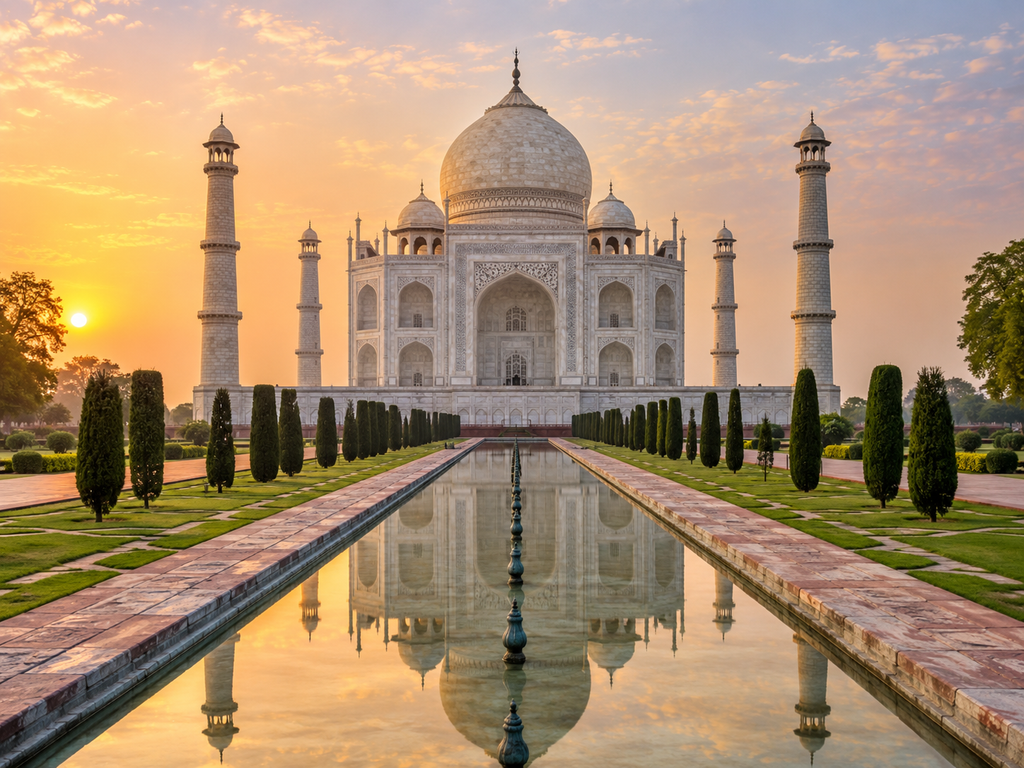
    The Taj Mahal was built as a monument to love. Its design raises personal emotion into something more enduring through harmony of form, rhythm, proportion, and geometry. Its great dome suggests wholeness and inclusiveness and, from an esoteric point of view, may also suggest feminine and receptive energy.

    The Taj Mahal, India

    Beauty therefore becomes more than decoration.

    It is a way of bringing harmony into physical form.

    The arrangement of a room, the placement of an object, the use of color, the quality of light, a garden, a piece of music, a painting, or a great work of architecture can all influence consciousness. The sensitive person feels the difference between an environment filled with discord and one created with care and harmony.

    To live with beauty is to continually remind ourselves that life need not be governed only by usefulness, material concerns, or disorder.

    Beauty brings another quality into experience.

    It lifts the eye beyond the object.

    It reminds us of harmony when the world appears chaotic.

    It gives physical form to something inwardly sensed as order, balance, and perfection.

    For me, this is why beauty belongs to the spiritual life. It allows something of the Divine to become visible in ordinary existence.

    A life of beauty does not require wealth or grandeur. It requires sensitivity—the ability to recognize harmony, create it where possible, and surround oneself with things that elevate rather than diminish consciousness.

    Beauty becomes spiritual when it brings the qualities of harmony, order, dignity, and the Soul into everyday life.

  • THE ARTIST AS SPIRITUAL VEHICLE

    What makes the artist a spiritual creature?

    The truly inspired artist is more than a person who has acquired technical skill. The gifted painter, musician, poet, sculptor, or other creative person may become a vehicle through which a spiritual idea takes physical form. The artist may never achieve fame or recognition, but for the sincere artist the metaphysical process remains much the same.

    The process begins with a vision, or an apprehension of the plan. An idea enters consciousness with unusual force and becomes something the artist feels compelled to express. It may arrive as an image, an impression, a feeling, a sound, or an overwhelming idea. Whatever its form, the artist recognizes something not yet manifested.

    It becomes the ideal.

    The artist cannot convey this ideal unless there is sufficient ability to give it form. Without developed skill, the vision may remain only an idea in the mind. Technique is therefore necessary, but technique alone does not create inspiration. It provides the means through which the inspiration can descend into form.

    Once the idea is apprehended, the artist enters into a deep concentration upon it. There is a withdrawal into the stillness of self. Too much chatter, distraction, or interruption makes it difficult to gather the inner resources necessary to create something of significance.

    The artist must become one with the ideal.

    This concentration is similar to meditation, although the artist may never call it meditation. Anyone completely focused upon a creative plan experiences something of this condition. Attention becomes so absorbed in the work that ordinary awareness of self begins to disappear.

    The ego is no longer the important consideration.

    The work becomes important.

    The artist becomes receptive to that which is seeking expression through the work of art.

    The idea must then move from the mental level into the emotional nature. An artist is usually deeply connected emotionally with what is to be created. Emotion supplies the drive, movement, and intensity needed to carry the idea toward manifestation. The artist does not merely think about the work; they desire to bring it into existence.

    Finally, the idea reaches the physical plane.

    The painter begins to paint. The sculptor works the stone or clay. The composer gives sound to the musical impression. The writer searches for the words. What began as something intangible is gradually brought into material form.

    This is the creative process: the descent of an idea from an unseen source through the mind and emotions until it can be manifested physically.

    When the work is completed, the artist usually wishes to share it. Art is communication. Something perceived inwardly by one individual is offered outwardly so that another person may see, hear, feel, or respond to it.

    In this way, the artist becomes not only a vehicle but also a messenger.

    The artist receives an impression, translates it through individual consciousness and skill, and brings it into a form that can be shared with others. The message may be beauty, harmony, conflict, sorrow, joy, truth, or some glimpse of an ideal that cannot easily be expressed in ordinary language.

    For the spiritually directed artist, this sharing becomes a form of service.

    The life of the creative artist therefore resembles other aspects of spiritual practice. In meditation, the source is contacted; through inspiration, an idea flows; through concentration, it is held steadily; through emotion, it receives the impulse toward manifestation; and through physical skill, it is finally given form.

    The artist serves as the intermediary between the unseen idea and its visible expression.

    For a moment, consider your own creative experiences. What has it been like to write music, compose a poem, create a painting or sculpture, design something, or bring into existence an idea that previously existed only within your mind?

    Was there a point when you became so absorbed that you lost awareness of yourself?

    Was the work, for that moment, more important than the person creating it?

    Perhaps it is at such moments that the artist most clearly becomes a spiritual vehicle—the personality withdraws, the ideal takes precedence, and something from the inner life is permitted to enter the world through creative expression.

  • THE SPIRITUAL IN ART

    Spirituality and art share similar dimensions. One can certainly be creative without being spiritual, but the spiritual process itself is creative. It reaches beyond the ordinary, senses an ideal, and attempts to bring something of that ideal into manifestation.

    Art is often judged by technical ability—the mastery of drawing, perspective, composition, color, form, or materials. These skills are important, but they do not necessarily make a work of art spiritual. Spirituality in art transcends technique. It is something brought through the work that touches a deeper level of consciousness.

    Art begins with an ideal held within the mind of man. From an esoteric point of view, the artist may intuit something of the Divine plan and attempt to give that impression physical form. Beauty is one expression of that ideal. During moments of inspiration, the artist may reach beyond the personality toward the universal mind and bring back some reflection of Divine beauty.

    The spiritually sensitive artist can therefore make an ordinary subject extraordinary.

    A painting does not have to portray angels, saints, or religious ceremonies to be spiritual. A peasant, a child, an interior room, a landscape, or a simple human gesture may contain spiritual qualities when the artist perceives something beyond its outer appearance.

    Rembrandt’s Return of the Prodigal Son is a good example. The subject is a human encounter: a repentant son kneels before his father. Yet through light, gesture, composition, and emotional depth, the scene becomes much more. It suggests the aspirant returning to the Father, forgiveness, compassion, humility, and spiritual homecoming. Light appears to come from an almost unknown source and transforms an ordinary human moment into something sacred. Your original comparison with the portrait of Louis XIV makes this distinction especially clear: one emphasizes inward spiritual meaning, while the other deliberately emphasizes outward splendor, status, and personality.

    Sacred is an important word when considering spiritual art.

    For centuries, religious art used symbolism, color, architecture, sculpture, and stained glass to communicate ideas that could not always be expressed through words. A symbol might convey several levels of meaning at once. Color also carried meaning; blue, for example, became associated with the Virgin Mary in Western Christian art.

    Imagine the effect of entering a great cathedral centuries ago. Ordinary life outside might have been dark, poor, and harsh. Inside were soaring columns, carved stone, gold, sacred images, tapestries, ceremonial garments, and brilliant stained glass illuminated by the sun. The entire environment lifted the eyes and the consciousness upward. Architecture, color, light, symbolism, and proportion combined to create the sense of entering another world.

    The cathedral itself became a spiritual work of art.

    Its towers reached upward. Its interior lines drew the gaze toward infinity. The artists and craftsmen who created it brought spiritual ideals into physical form.

    Spirituality can also be expressed through abstraction. Wassily Kandinsky believed that art could communicate spiritual realities through color, movement, rhythm, and symbolic form without depending upon recognizable objects. The symbol became a product of the intuitive mind. Through abstraction, the artist could attempt to express universal rhythm and unity rather than merely copy the visible world.

    William Blake approached spirituality through visionary imagery. His angels, allegories, and mystical figures arose from an inner world that, from an occult perspective, penetrated beyond ordinary physical consciousness. Other artists have brought back very different impressions. Hieronymus Bosch portrayed disturbing and fantastic images that may be interpreted as contact with darker psychic levels.

    The spiritual in art, then, does not always mean serenity or conventional beauty. It may awaken, disturb, challenge, or illuminate.

    Modern artists sometimes confront us with images we do not immediately understand. Such art can force consciousness out of complacency. Giorgio de Chirico’s strange streets, unnatural perspective, long shadows, and mysterious figures create an atmosphere of uneasiness. Something is suggested beyond what is actually shown. The viewer is required to participate, to interpret, and perhaps to confront something within the unconscious.

    This is one of art’s spiritual functions.

    The artist can make visible something that cannot easily be spoken.

    A great work of art does more than reproduce the outer appearance of life. It reveals another dimension within it. Through light, color, symbol, form, imagination, and intuition, the artist may transform the commonplace and allow us to glimpse something of the ideal behind the physical world.

    The spiritual in art is the ability to perceive the Divine within life and to bring some reflection of that perception into form.

  • THE ROLE OF THE ARTIST

    The artist has a special role in the affairs of mankind. While society moves forward through commercial, financial, technological, and public services, the artist provides the creative touch that enhances quality of life, adding beauty, vision, and spiritual content.

    The balance between concrete and abstract powers has always been a struggle, with society generally favoring the extroverted, convergent thinker. Where success is measured primarily by financial gain, the artist may lack the rewards and fiscal stability found in more conventional occupations. In a world governed by supply and demand, only a portion of society actively supports the arts, while many people remain unaware of the aesthetic and spiritual contribution an artist makes to the community.

    Eventually, a reckoning may occur in society’s consciousness. As the Fourth Ray of Harmony through Conflict, Beauty, and Art becomes increasingly influential, the artist’s role may become more prominent and better understood.

    Regrettably, artists have often been viewed as impractical or incompetent because their thought processes may be abstract, intuitive, and difficult for the concrete thinker to follow. The stereotypical artist is sometimes pictured as living a bohemian and unconventional life, perhaps accompanied by addiction, irresponsibility, or disregard for accepted behavior. Yet stereotypes reveal little about the true creative person.

    Artists may possess unusual sensitivities that make them especially responsive to beauty, emotion, atmosphere, and the harsher aspects of a materialistic world. In a society that measures success largely by financial status, the value artists contribute can easily be overlooked.

    The struggling artist often faces both the myth of failure and the very real difficulties imposed by a society that may not adequately reward creative work. The image of the “starving artist” is no more accurate as a description of all artists than the “absent-minded professor” represents every intellectual or the “computer nerd” represents everyone working in technology. We should set these stereotypes aside so we can consider the vital role the artist actually plays in society.

    In many traditional and Indigenous societies, the maker of sacred images, ceremonial objects, garments, masks, paintings, music, or other ritual forms occupied an important position within the community. Creative work could be inseparable from religious ceremony, healing, ancestral tradition, and the transmission of sacred knowledge. The artist might therefore work alongside the priest, healer, or shaman, contributing to ceremonies intended to restore harmony or connect the community with spiritual forces.

    Mandalas, sacred objects, ceremonial garments, masks, music, dance, and symbolic designs were not made merely for decoration. Their colors, forms, symbols, and rhythms contributed to the ceremony’s meaning and power.

    The modern artist does not ordinarily function as a healer in this traditional sense, although art’s healing potential continues in art therapy and other therapeutic uses of visual art, music, movement, and creative expression. A trained art therapist may use art to help individuals explore feelings and experiences that are difficult to express verbally. Even outside a therapeutic setting, artwork can affect emotions and the subconscious in ways the artist may never fully know.

    Art is a symbolic tool that can surpass language.

    It can cross barriers between nations, cultures, religions, and different value systems. Certain forms and symbols are understood immediately, while others acquire their meaning through a particular culture or tradition. A work of art may communicate an emotion long before its intellectual meaning has been understood.

    Some paintings provide narrative or historical documentation of a people or civilization. More abstract and sacred symbols may convey ideas and principles that cannot be communicated so easily through ordinary language.

    The artist is therefore not only a communicator but also a recorder and teacher.

    Art history allows us to read portions of humanity’s history through its visual record. Works of art preserve the concerns, ideals, conflicts, beliefs, aspirations, and states of consciousness of the cultures that produced them.

    Our modern artists continue this role. They record humanity’s conflict within an increasingly technological society, explore abstract ideas, use new technologies as creative tools, and attempt to embody the dominant forces of their time within works of art.

    In the role of visionary, the artist may contact what I would call the universal mind and catch a glimpse of the ideal.

    That glimpse does not necessarily arrive fully formed. It may first appear as an intuition, an image, an impression, or an idea whose significance is not yet understood. The artist then struggles to bring that impression into manifestation.

    Such efforts are not always immediately appreciated. Artists who introduce unfamiliar forms or ideas may be ridiculed or misunderstood because the public has not yet developed the consciousness necessary to respond to what the artist is attempting to express. Years or even decades may pass before the value of a particular artist or movement is recognized.

    Art museums demonstrate how powerfully artistic visions can survive their own time. They continue to inspire viewers through timeless expressions of beauty, drama, devotion, conflict, intellect, emotion, and imagination.

    Each period of history has pursued certain dominant ideas that reflect the consciousness and ideals of its age. Historians can interpret those periods through the eyes of artists.

    For centuries, Western artists portrayed the great spiritual ideas represented by the Church. Later, they recorded the power and ceremony of monarchy. Gradually, the ordinary person entered art more prominently, and the concerns of everyday human life became worthy subjects in their own right.

    The Renaissance reflected a rebirth of intellectual inquiry and interest in humanity and the classical world. Romanticism emphasized emotion, imagination, nature, and the ideal. The Impressionists explored the changing effects of light and color upon visual perception. Modern artists confronted industrialization, technology, fragmentation, abstraction, and the changing relationship of the individual to an increasingly impersonal world.

    Throughout these changes, the artist has done more than record what already exists.

    The artist has often sensed what is approaching.

    Through sensitivity, intuition, imagination, and the abstract mind, the artist reaches toward ideas that may not yet have taken recognizable form within society. Art can therefore act as both a record of human consciousness and a precursor of its development.

    We look to our artists not merely to decorate the world we already possess, but to envision what humanity may become next.

    This version stays quite close to what you wrote. I especially preserved your final idea because I think it is the real conclusion of the article: the artist not only records a civilization but may anticipate the consciousness that is coming next.

  • THE IDEAL CLASSROOM

    Annie Besant, one of the most important leaders of the Theosophical Society, had significant ideas about childhood education. She was an ardent supporter of education and established schools in India, including the Central Hindu College in Benares in 1898, which later contributed to the development of Banaras Hindu University.

    Besant believed that each child has special gifts suited to the development of particular interests. Talents may arise in many different areas, but it is often up to the teacher to discern, encourage, and help develop these abilities.

    In rare situations, a young prodigy is recognized. These extraordinary abilities seem to defy ordinary methods of training and appear to bring a talent to fruition very early in life. Prodigies such as Mozart demonstrated remarkable gifts that, from the viewpoint of reincarnation, could hardly have developed within a single incarnation.

    Such individuals may rapidly recapitulate abilities acquired through many incarnations of focused study and training and then flourish as gifted artists, musicians, mathematicians, or thinkers in the present life. After many incarnations of development, their one-pointed concentration upon a particular talent may serve a divine purpose by bringing something of value into humanity.

    These mental giants are exceptions to the rule. For most of us, training, motivation, intensity, patience, and focused hard work are necessary before our abilities can mature.

    More often, a child must pass through graduated levels of experience and sample many different subjects before discovering a true direction. A love of science or engineering may not emerge until the mental body is more fully developed later in life. A child may have a strong interest in sports that eventually gives way to more intellectual challenges. Preferences change as children encounter the many possibilities offered through education.

    For this reason, the young child should be given a broad selection of subjects and experiences. Later, as maturity develops, selection and discernment become more important. Certain inclinations become increasingly prominent in the personality and may eventually be nurtured into a primary focus or life work.

    Each child may possess special gifts that remain dormant until, like a seed, they suddenly begin to blossom.

    This may be the call of the Soul.

    Children should not be coerced into learning but should be helped to discover themselves through study and experience. A child who is loved and encouraged in a nurturing environment is much more willing to try because failure is not something to fear.

    Children want the approval and respect of a teacher they admire. They often take great pleasure in demonstrating what they have learned and showing that they have reached a new level of understanding.

    Coercion can have the opposite effect. Excessive pressure may create resentment, resistance, loss of interest, truancy, or unwillingness to complete schoolwork. Difficult behavior may arise from many sources—family circumstances, fear, discouragement, relationships with authority, or a classroom in which the child does not feel accepted.

    Children need encouragement so that their individual qualities have room to expand.

    Reason should also be cultivated rather than relying too heavily upon rote memory.

    Too often, success in the classroom is measured primarily through test scores. What can most easily be measured are concrete answers—dates, names, places, definitions, and other facts. Children quickly learn how to respond to this system. They memorize material, take the examination, and may soon forget much of what they have learned.

    Information is much more likely to remain when it has meaning.

    A historical event may suddenly become fascinating because something about it awakens the imagination. From an esoteric point of view, there may even be a karmic connection with a particular period or culture that produces an unexpected emotional response.

    The Napoleonic Wars, for example, may be dull information to one student and intensely fascinating to another. The difference may lie not simply in the subject itself but in the personal significance it carries for the individual.

    Subject matter is less easily forgotten when it becomes personally meaningful.

    Education should therefore encourage students not merely to memorize the parts but to understand the whole. Students should be encouraged to think freely, express an opinion, defend a judgment, question assumptions, and understand why events occurred and what consequences followed.

    The parts have value, but they gain greater meaning when their relationship to the whole is understood.

    Lastly, and perhaps most importantly, children should be exposed to beauty.

    Learning continues on a subtle level wherever beauty is present.

    Beauty develops refinement, sensitivity, harmony, and an awareness of relationship.

    What creates harmony?

    Consider a classroom in which children are running around, shouting, fighting, and continually disturbing one another. Where chaos dominates, there is little opportunity for harmony, concentration, or beauty. The teacher may spend so much time restoring order that an intended story, creative activity, or lesson is abandoned altogether.

    Disharmony affects everyone in the room.

    The ideal classroom should therefore contain some degree of beauty and order. Beauty uplifts children and creates an atmosphere in which they can more readily express themselves.

    Beauty can exist in the arrangement of the room, the use of color, displays of artwork, plants, books, natural objects, music, and the thoughtful organization of materials.

    Materials should also be accessible.

    Anyone who has been in a creative mood and suddenly discovered that a pencil, eraser, brush, paint, paper, or book cannot be found knows how quickly the creative impulse can be interrupted.

    Disorganization creates its own kind of disharmony.

    A good classroom should have a place for things, and children should gradually learn to respect and maintain that order.

    Time is also an essential part of creativity.

    A child who is deeply involved in a drawing, construction, experiment, or imaginative project needs sufficient time to become absorbed in it and bring it toward completion. Creativity is easily interrupted when activities are continually stopped before the child has had an opportunity to develop the idea.

    The ideal classroom therefore provides not only instruction but variety, encouragement, reason, beauty, order, materials, and time.

    Its purpose is not merely to fill the child’s mind with information.

    It is to create the conditions under which the individual child can discover what is already waiting to unfold.

  • THE ENERGY OF ART

    Paintings convey energy to both the artist and the viewer. The artist seizes upon the creative process and brings into the artwork a quality or idea that reflects the noumenon of spirit. A work that succeeds in doing this gives the artist great satisfaction. Each time the picture is revisited, it may renew and expand the energy that connects the artist with the original experience.

    At the most immediate level, art carries sensory energy. Color, contrast, scale, rhythm, line, texture, sound, and movement affect us before we consciously analyze their meaning. A violent red-and-black painting creates a very different response than a pale, quiet landscape. A cathedral, a mandala, or a turbulent abstract painting can change our attention, mood, and bodily response simply through the force of its forms.

    It also carries emotional and psychological energy. The artist concentrates feeling, memory, intention, and imagination into a work. The viewer may later respond to that concentration, sometimes very strongly. A painting can continue to transmit something long after the artist has left the room—or even centuries after the artist has died. The original emotional experience is no longer physically present, yet something of its quality remains accessible through the work.

    In the same way, viewers of great art may be invited to share in the numinous experience of the creator. Buddhist mandala art is used specifically for this purpose. Through contemplation and meditation, the mandala draws the viewer beyond its physical design toward the spiritual source that the symbol represents. The image becomes more than decoration; it becomes a vehicle for consciousness.

    There is also symbolic energy. A symbol may contain many ideas within a single form. A circle, cross, spiral, mandala, sun, serpent, doorway, or other powerful image can awaken associations far beyond its visible shape. Symbols compress meaning. Through contemplation, the viewer expands that meaning again.

    This helps explain why symbolic art has played such an important role in spiritual and ceremonial traditions. In many cultures, art has been regarded as a source of power rather than merely as representation. Indigenous peoples of Australia and the Americas, as well as peoples of ancient Europe, created images associated with animals, ancestors, fertility, hunting, renewal, and spiritual forces. Aboriginal peoples of Australia recreated ancestral forms and sacred designs in order to renew their relationship with the ancestral past. Whenever a ritual retraces or recreates a powerful symbol, the meaning contained within that symbol is reinforced, and its energy is renewed for those participating in the ceremony.

    Art is therefore a vehicle for visualization. It enables the viewer to enter into a world created through the artist’s intention to invoke a particular quality, idea, or essence. Representational art may awaken feeling, memory, and recognition through familiar forms. Symbolic and abstract art can work differently, inviting the mind to search beneath the visible image and connect several levels of meaning at once.

    The most powerful art may move beyond immediate sensation and emotion into the abstract mind. Here the viewer is no longer responding only to what is represented but to the relationships, patterns, ideas, and qualities concealed within the work.

    This is where art becomes especially important from an occult point of view.

    The artist does not necessarily invent everything that appears in the work. At times the artist may become receptive to something beyond the personality—an ideal, archetype, intuition, or higher impression. The artwork then becomes a vessel through which that impression is brought into form.

    The abstract mind reaches toward the unseen. The artist gives that unseen impression physical form through color, line, shape, sound, movement, or material. The viewer then encounters the finished work and may reactivate something of the original experience through perception.

    In this sense, art becomes a source of energy when an inner impression is given form strongly enough to awaken a corresponding response in another consciousness. The artist concentrates the idea; the artwork holds its form; the viewer responds and renews its meaning.

    Not every artwork carries the same quality of energy. Art may transmit serenity, devotion, joy, grief, agitation, fear, sensuality, aggression, humor, beauty, or confusion. What is important is that the work may convey something of the quality of consciousness from which it was created.

    The energy of art, therefore, does not lie only in pigment, stone, sound, or symbol. It is also carried in the consciousness embodied through those materials.

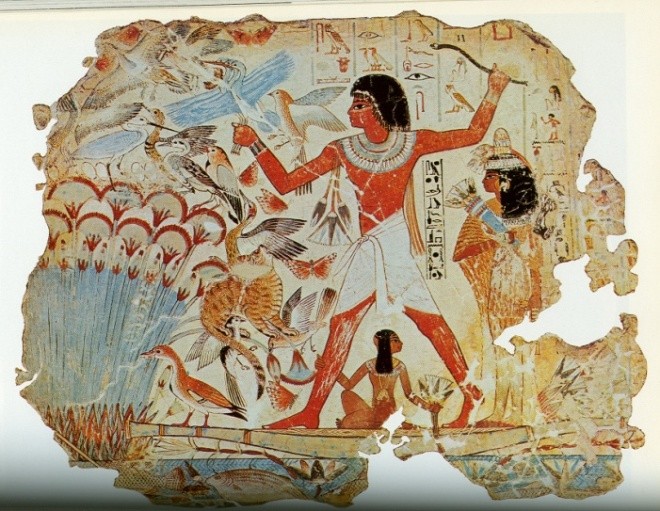
    The Egyptians understood the difference between ordinary representation and symbolic form. Scenes of daily life could convey information about people, occupations, rituals, animals, and events. Sacred symbols and hieroglyphic forms could contain meanings that extended far beyond their immediate appearance.

    To the initiated, a symbol could operate on several levels at once. Everyone could see its outer form, while its deeper meaning required contemplation, meditation, or spiritual understanding. Secret knowledge was not hidden for secrecy’s sake; it could be understood only when consciousness had developed enough to perceive what the symbol contained.

    The symbol therefore becomes more than an image.

    It becomes a doorway.

    Through color, form, emotion, symbol, and spiritual intention, art can connect the visible and invisible worlds. The artist receives, concentrates, and gives form to an impression. The viewer encounters that form and may respond to it on sensory, emotional, symbolic, mental, or spiritual levels.

    In this way, art continues to radiate long after its creation.

    Its deepest energy may not reside in the physical object at all, but in the quality of consciousness embodied within it and awakened again in those who experience it.

  • THE CREATIVE PERSON


    The creative person connects with the sublime and sees the universal, or the whole, in everything. Educators who have studied creative people have researched these qualities to identify what makes them creative and how they develop it. What are the creative components of a personality? You will see a distinct difference between a creative person and their colleagues. First, a creative personality tends to be more introverted than extroverted. That is, they derive stimulation from an inner source rather than external factors.   By introverts, I mean they draw on their inner life as a stimulus for their work and behavior; in other words, they have to be alone and go within. They can live alone but don’t need popularity or external stimulus to be motivated. They find an internal stimulus.

                An extrovert finds their stimulus from the outside world. They need stimulation from people, and that is what motivates them; they shine when they are out in the world. Creative people have a sense of humor, and humor helps you see the relationship between the parts and find humor in it.  Someone who is not creative does not see the point of humor because they are focused on the specific. The reality as they perceive it to be. So the ability of the different parts and incongruities makes the situation numerous

    .           The artist senses the ideal, inspired by a sunset, a flower, or metal or glass; something inspires them to see a reflection of the divine in it, and they want to portray it. This could be beauty in the home. They can sense that a specific arrangement of furniture or decoration brings some refined energy to that area; an ideal simplicity, the ideal could be harmony, or color, called “the presence”; the ideal could be devotion.  What is the ideal? Those who are not creative go through life not even noticing anything. They couldn’t care less what the environment looks like if it is useful to them, if there is a bed and a chair that is simply enough for them. If there is clutter in the kitchen, yard, or garage, it has no significance for them except as a collection of things to be used for their concrete function. 

    But a creative person cares a lot about harmony and cleanliness and is sensitive to the vibrations that these things bring into their life. We should speak about that because it has a lot to do with the beauty you bring into your life. Are you sensitive to vibration? If there is a lot of clutter, especially if it was collected by other people and brought into your own, you are accepting the energy of their thought forms and ideas surrounding it.

                How does art come close to the alignment of the soul? These are qualities of the soul: beauty, truth, harmony, and order, and this can be achieved through the acquiring of these qualities through meditation. In meditation, it is very much like the artist within. You have to be introspective, separated from society in a place where you are alone and quiet; go within yourself to draw from the internal divine self the truth of the ideal. It is a solitary path, the open one that is not necessarily devoid of friends or relationships but includes how to discern the external world from that which you need to go inside, and from creativity, you unite with the divine. Through meditation, you learn how to be the observer, to withdraw and watch the world, to see the parts and unite them with the world. I’m not attached to the world at that point. A creative person is engrossed in the deepest part of creativity by being selfless. They are attached only to the ideal they are trying to create. Intuition leads to the ideal which they wish to represent.  Therefore, the path of meditation will lead to learning how to contact the creative within.

                 “Hence, the work of meditation tends to extract and awaken abstract consciousness, both emotions and mentality. “

  • ARTIST AS HEALER

    The artist has a special role in human affairs. Yet artists have sometimes been viewed with suspicion—dismissed as impractical, scatterbrained, or lacking a place in the “real” world. This is one of the most unfortunate misunderstandings of the artist.

    There is another and much older view. Artists follow a calling that often requires years of discipline and training. In many traditional cultures, artists and craftspeople held an honored position within the community and sometimes worked closely with priests, shamans, and ceremonial leaders.

    They created mandalas, sacred objects, ceremonial garments, masks, paintings, music, and other forms used in ritual. These creations were not regarded merely as decoration. They could help focus attention, evoke emotion, strengthen belief, create an atmosphere of reverence, and contribute to ceremonies intended for healing or spiritual transformation.

    The modern artist seldom participates in healing rituals in this traditional sense. Yet art continues to affect people deeply.

    Color, form, sound, movement, rhythm, and symbolic imagery can influence mood, awaken memory, bring comfort, encourage contemplation, and sometimes reveal feelings that have been difficult to express consciously.

    A work of art may calm one person and disturb another. It may bring forgotten emotions to the surface or create a sense of harmony and release. Its effect may occur quietly, without the viewer fully understanding why.

    In this sense, the artist may still function as a healer—not necessarily by curing illness, but by creating conditions in which people can experience beauty, emotional release, insight, reflection, or renewed awareness.

    The artist gives form to what is often invisible.

    By doing so, art can become a bridge between the inner and outer worlds, allowing something deeply felt to be seen, heard, or experienced.

    The healing power of art may therefore lie not only in the object itself, but in its ability to awaken something within the person who encounters it.

  • ART AS PART OF A COMPLETE EDUCATION

    Art should not be regarded merely as recreation after the supposedly important subjects have been completed.

    Education should develop the entire individual.

    Concrete knowledge teaches the child how the physical world functions. Art develops another capacity: the ability to imagine something that does not yet exist and then find a way to bring it into form.

    From an esoteric perspective, this creative faculty has a spiritual dimension. Creativity encourages sensitivity to beauty, harmony, relationship, and the inner life. As consciousness develops, these qualities may eventually contribute to a greater responsiveness to the soul. Your original text specifically connects childhood exposure to beauty and creativity with this later spiritual development.

    The purpose of art education, then, is not simply to produce artists.

    It is to educate human beings who can observe carefully, think imaginatively, respond sensitively, appreciate beauty, and create rather than merely imitate.

    A complete education should teach children how to know the world.

    It should also teach them how to imagine what the world might become.

    This is now a much better length and focus for your website. The material we removed can be used almost intact for The Creative Person, The Abstract Mind of the Artist, and The Spiritual in Art, so none of your ideas need to be lost.