Animals were the result of experimentation, combining beaks, wings, and claws with scales, and are characterized as mythological beasts in jewelry, sculpture, and glyphs depicting anthropomorphic shapes. These shapes are carved on the stones of Ica,* Peru, and seen on many ancient glyphs. These extraordinary animals, such as dragons, dinosaurs, etc., were as large as the giant men of their day. Eventually, the creators of these forms refined their designs into categories of winged creatures of the air, mammals of the earth (horns, scales, tails), and those of the sea. Some forms were beneath the soil, in caves, holes, and grottos, but were classified as mammals.
Before the reappearance of these forms, a cataclysm wiped away the old forms that were useless and impeded programs that were considered a “failure.” Still, it was an evolving design by its creators. When new forms were created, extraterrestrial Atlanteans were able to control their experimental forms by projecting a thought or image into the etheric sheath (unconscious), which humans perpetuated and universally accepted as their own ideas. This etheric sheath is also the “group spirit” of animal form that guides its instincts. It was decided that some higher animal forms would be allowed to penetrate intelligence or the plane of mind for their development.
Strong tribal taboos kept groups pure and uncontaminated from one another, allowing ET creators to observe each group’s experiments. Only later was cross-breeding allowed to evoke certain traits from groups that had evolved characteristics.
The creators from another planetary system, a council of seven representing different stellar systems, decided to reduce the scale of forms on Earth since they realized that the Earth would be limited in space, volume, and mass—the new animal forms were reduced in size, and man’s height was limited to five feet. Over time, the height was adjusted as the Earth was able to accommodate an increased size. Equilibrium between man and beast was reached.
ATLANTEAN BURIAL PRACTICE
The Atlantean man contacted the etheric mind of his creators, who believed that the physical form could be used again when the “life” force left the body at death. Their thought was allowed to penetrate the etheric sheath, where Atlanteans contacted their “spiritual ancestors” or creators. So Atlanteans began to protect the body from disintegrating at death, believing that the life spirit would again inhabit these bodies. But the creators learned that this was not the case, and abandoned this idea. However, these ideas persisted among the Egyptians and other cultures until they were discarded.
Astrocartography maps astrological influences in an attempt to identify the most promising places for an individual to live during an incarnation—places where one may be less challenged by difficult circumstances, or where particular locations may appear more favorable for personal or spiritual growth.
Yet karma cannot be avoided or lessened simply by choosing a location, for it is often through challenge that the swiftest stimulus for growth occurs. If life were entirely ease and accommodation for the ego, there would be little progress for the spiritual self. Thus, astrocartography may do a disservice when it encourages the inclination toward a passive or protected life.
We cannot escape responsibility for karma by changing our location. Karmic experience follows and adapts to circumstances. Sooner or later, one must be prepared to accept the call and meet whatever conditions karma has provided. Location itself holds less attraction or meaning for the awakened individual, who recognizes that every place contains the potential for advancement.
The spiritual student should therefore become reconciled to the environment the soul has sought for its experience. Place of birth, family, country, physical body, character, talents, associates, and the quality of one’s environment may all reflect conditions carried forward from previous incarnations and accumulated experience.
Some places may provide a greater potential for karmic experience and may therefore accelerate existing karma, particularly in locations where political events are intensified or physical destruction is imminent. Such areas may attract individuals or groups who participate in the collective or planetary karma of that time.
Yet one should neither choose a location merely to escape the karma that is due nor rush in where angels fear to tread in an effort to hasten spiritual development. The spiritual student should be able to adhere to the disciplines of the Path wherever he or she may be, living beyond many of the mundane and planetary influences that dominate the unawakened individual.
At the same time, one need not deliberately seek out areas of political tension, physical danger, or economic instability under the mistaken belief that such circumstances will accelerate karma. Karma is responsive and adaptable wherever one happens to be. The wiser course is to accept the circumstances of the moment, neither seeking nor avoiding favorable or unfavorable karma, while recognizing the consequences of earlier thoughts and actions that may still require fulfillment.
If relocation occurs as a natural unfolding of events, it may be regarded as an opportunity for extended service, personal development, and the sharing of new experiences with others. Man is free to choose some of the conditions of life, but karma follows natural law and establishes the limitations and opportunities through which the individual is tested.
One may choose to live near or far from a city, in a rural or metropolitan environment, in a particular climate, or within a chosen profession. Yet previous karma remains present within the parameters of those choices. If poverty must be experienced, poverty may follow. If business success or a marital relationship is part of one’s experience, these opportunities may arise wherever one happens to be.
Individual karmic factors may influence wealth, health, relationships, and other personal circumstances, while collective and international karma influence communities and nations through economic conditions, markets, war or peace, inflation, commerce, and social change. These larger forces inevitably affect the apparent freedom of individual choice.
Regardless of physical location, it may be useful to distinguish among three expressions of karma:
Present karma—events or conditions that must presently be experienced.
Karma of character—qualities and circumstances shaped by accumulated experience.
Evolving karma—future conditions and character created through present thoughts, decisions, and actions.
Karma is continually being created through change. Individuals also participate in the collective karma of families, cultures, communities, and nations as they move from one society to another.
The laws of karma are not confined to a particular time or place. The soul is concerned with physical location only insofar as a location may provide a particular experience—through historical events, climate, collective consciousness, relationships, or other conditions.
The soul resides beyond the limitations of physical geography. Whatever is experienced on the physical plane is eventually assimilated by the soul as character and quality. It is this inner development, rather than the physical location itself, that ultimately contributes to spiritual growth.
From this perspective, astrocartography may offer an interesting map of planetary influences, but it cannot determine the destiny of the soul nor release an individual from the lessons that karma has placed upon the Path.
We are approaching the end of an era. From many sources, the idea of Armageddon—the end of the world—is reinforced. This could mean that the reality of world destruction is at hand or, metaphysically speaking, that it symbolizes a new and higher era in which the sheep will truly be separated from the goats.
The first thought is more prevalent among ecologically oriented people. We see the world slowly being cut up, abused, burned, and disposed of. The ozone layer above Antarctica has been damaged, allowing increased exposure to potentially harmful radiation. Rainforests are being cut down, our waters are polluted, and we are seeing the effects of a changing atmosphere in increasingly hot temperatures, droughts, floods, and devastating weather conditions. Ecologists have reason to worry.
But given even the most dreadful possibility of the destruction of this planet, we know that other planets and galaxies without number exist. We believe we have come from Orion, Sirius, Venus, Andromeda, and other stars, and that we will travel on to other galaxies and other soul experiences. Should this planet cease to exist, it would mean the cessation of physical life on Earth, not of life itself. We would incarnate elsewhere and go on.
This is not to say that destroying our habitation is right. Destroying property and simply moving on is never the solution. It is much like refusing to take responsibility for karma while waiting for bigger and better things in the next life. It is not that simple.
Changing people’s minds and behavior is a formidable task. In the end, destructive attitudes must change. Nature has a way of correcting destructive behavior with a critical, abrasive force. Atlantis may be considered an example of destruction brought about by a critical mass of negative mental energy. Collective ideas and tyrannical behavior led to its destruction, yet some Godly remnant survived and planted the seed for another age. Perhaps those who constitute the remnant of this planet today will also become the seed of a new age. When our ancestors needed help eons ago, were they not themselves “seeded” by star visitors?
I believe there has always been a greater, far-reaching plan for this planet. Even now, masters and planetary lords may be working behind the scenes to direct its positive growth. Forces work against them, but there are also those on Earth who have responded and are willing to help. Other planets may have been prepared as seedbeds for those unable to maintain a higher vibration. When their earthly incarnations are completed, souls may reincarnate in places appropriate to their development.
There is also the persistent theme that a percentage of humanity will not be “saved.” Christian missionaries once thought similarly about the salvation of native peoples. Is this the same metaphor for today’s condition—Heaven versus Hell—now disguised as a choice between materialism and initiation into the spiritual world? Has our thinking altered that much?
I do not dismiss the possibility that our age has repeatedly been warned to awaken consciousness, although the meaning of that awakening has been redefined through each century. Some religions imposed their dogmas upon others. So, too, we must permit others the freedom to discern the Path for themselves, lest our arrogance become our downfall.
On the other hand, this planet may not be annihilated. There are great demands upon the devas whose planetary work is being systematically disrupted. Nature has repeatedly demonstrated an extraordinary ability to adapt, repair, and transform. I recall, for example, the pollution of the Great Lakes in Wisconsin and Michigan and the remarkable efforts made to restore their health. Such recovery suggests that human intention and action, working in cooperation with the forces of nature, can reverse damage once considered inevitable.
My point is that this planet may be irreversibly damaged—or it may already be in the process of a great cleanup, with higher guides and devas assisting in preparing this world for a new age. In either case, individually and collectively, we can manage our resources more wisely.
Cleaning the planet’s toxins is only part of the problem. Man is the larger problem. If this planet is devastated by another world war, dangerous experimentation, chemicals, deforestation, or other destructive forces, life itself cannot end. The physical manifestation of life on this planet, in this dimension and round, may end, but all physical things have a cycle of birth, growth, and death. Even if this planet survives another billion years, it too will eventually die. In the meantime, as spiritually advised students, we can help our world survive as optimally as possible.
The second point I wish to make regarding Armageddon, should this planet survive, is that we may be approaching a major turning point on the mental and spiritual levels. A division may become increasingly apparent between those who are spiritually conscientious and those who do not respond to the urgings of the Path.
For those who remain astrally or emotionally polarized, the contrast between good and evil may become more pronounced. Corruption may absorb the weaker, and emotional forces may increasingly overwhelm society. Yet the remnant will continue quietly on its course, eventually moving toward experiences appropriate to its spiritual development.
This planet itself may become increasingly engaged in technology, experimentation, and selfish materiality. What, then, is our responsibility?
We should individually and collectively continue to raise consciousness wherever we can. This, perhaps, is the Armageddon we are facing today—not merely a final physical battle, but a choice in consciousness.
Remain steady in the light, pure in heart, and focused in the mind. Be an outpouring of love and light, individually and collectively. The spiritual vibration we attain affects the environment around us.
Service is not necessarily a matter of writing a book, teaching a class, or organizing an awareness group—although these, too, have their place. Regardless of where you are or what your destiny may be, the quality of your vibration will ultimately influence the community around you.
Within my spiritual understanding, pain has a place in the evolutionary experience of both animals and humanity. Human beings frequently learn through suffering, eventually coming to greater compassion, understanding, and love. In the animal kingdom, pain also serves an immediate biological purpose: it warns of danger, injury, and circumstances that should be avoided.
This does not mean that suffering itself should be regarded as desirable or that unnecessary pain is spiritually justified.
Within the esoteric teachings I follow, the animal kingdom is progressing along its own evolutionary path and gradually developing qualities that will eventually contribute to a more individualized consciousness. This is a spiritual interpretation rather than a scientific description of animal evolution.
Modern science has also greatly expanded our understanding of animal consciousness. Animals are no longer reasonably regarded as creatures acting only through instinct and conditioned emotional responses. Many species demonstrate learning, memory, problem solving, social awareness, communication, anticipation, and complex emotional behavior.
The familiar saying “Once bitten, twice shy” describes one simple form of learning: an unpleasant experience may cause an animal—or a human being—to avoid the circumstances associated with it. Yet animals learn in many other ways. They learn through observation, exploration, relationships, memory, reward, imitation, and experience.
Animals in the wild acquire behaviors appropriate to their environments through both inherited tendencies and learning. They may learn from parents, members of their social group, encounters with predators, available food sources, changing environments, and experience accumulated throughout life.
Domesticated animals live within another kind of environment—one strongly influenced by human beings.
The relationship between humans and companion animals is far more profound than was once generally recognized. Dogs, in particular, have evolved in close association with humanity and have become unusually responsive to human gestures, voices, expressions, and emotional states. Research has even found evidence of emotional synchronization or emotional contagion between dogs and their human companions.
Thus, the emotional atmosphere we create around animals matters.
A calm, compassionate person may provide an animal with security. Fear, anger, neglect, unpredictability, or aggression may create anxiety. Our responsibility is therefore not merely to control an animal but to establish a relationship in which the animal can feel safe enough to learn and develop.
Animals also respond to one another’s experiences. Social species may learn by watching companions, react to the distress of others, provide comfort, or change their behavior after witnessing danger.
Their responses to death are also more complex than once assumed.
We cannot know that animals understand death in precisely the manner human beings do. Human beings possess language and can contemplate their own mortality, imagine the distant future, and construct religious and philosophical explanations of death. Nevertheless, observations of elephants, primates, whales and dolphins, corvids, and other animals demonstrate that some species distinguish living companions from dead ones and may show prolonged attention, altered behavior, or grief-like responses following a death.
Within the esoteric philosophy of the group soul, I understand the experiences of individual animals as contributing in some manner to the greater consciousness of their species. In this interpretation, the life and death of an individual animal are not meaningless. Experience becomes part of the evolutionary development of the greater life to which it belongs.
This concept is spiritual rather than scientific, but it provides one way of understanding the relationship between individual suffering and the evolutionary journey of the animal kingdom.
Those who care for animals perform an important service. Through our relationship with animals, humanity itself is being taught compassion.
Companion animals, in turn, often demonstrate remarkable loyalty, trust, affection, patience, and peaceful companionship. These relationships may contribute to the development of both the animal and the human being.
Domestication does involve dependence. An animal living with human beings relinquishes much of the independence available to its wild ancestors. It depends upon people for food, shelter, medical care, exercise, companionship, safety, and opportunities to express natural behaviors.
That dependence gives humanity a considerable moral obligation.
Training and discipline should therefore not require deliberate suffering. Modern understanding of animal behavior increasingly favors reward, patience, consistency, and positive reinforcement rather than fear or pain. An animal does not need to suffer in order to learn.
Within my spiritual belief, I have sometimes considered whether animals that incarnate into close association with humanity do so as part of their evolutionary experience. The companion animal encounters another order of consciousness and participates intimately in human emotional life.
If this is so, the relationship carries obligations in both directions.
The animal offers companionship, loyalty, trust, and an extraordinary willingness to live within the human world. Humanity, possessing greater power over the conditions of that animal’s life, has the responsibility to offer protection, kindness, understanding, and compassionate guidance in return.
Pain may sometimes be unavoidable in earthly existence. Injury, illness, aging, predation, and death are part of biological life.
Cruelty is different.
Cruelty is not an evolutionary necessity. It represents a failure of compassion.
Perhaps one purpose of the animal kingdom is not simply the evolution of animals themselves, but the evolution of humanity through our treatment of beings more vulnerable to our power.
The manner in which we treat animals reveals something about the development of our own consciousness.
If suffering can teach, one of its most important lessons should be our determination not to cause suffering unnecessarily.
What is the relative perspective one should have regarding the experimentation and use of animals for the study of medical cures, the psychological studies of animal behavior, and associated research on organisms?
The question of animal research presents a difficult conflict between compassion for individual living creatures and the desire to relieve suffering through scientific knowledge.
Animal-protection and animal-rights advocates have raised legitimate concerns about pain, confinement, unnecessary experimentation, and the moral status of animals. Their positions vary considerably. Some oppose virtually all experimentation on animals, while others support research under limited circumstances when suffering is minimized and no adequate alternative exists.
At the same time, research involving animals has contributed substantially to the understanding of biological processes, disease, medicines, and both human and veterinary health. The ethical question therefore cannot be reduced simply to whether animals should or should not be used. It also asks what degree of necessity exists, what suffering is involved, whether the knowledge sought is sufficiently important, and whether the same information can be obtained by another method.
Within my spiritual understanding, all earthly life participates in an immense process of exchange and transformation.
Nature reveals this constantly. One organism nourishes another. Plants absorb sunlight, minerals, water, and substances from the soil and transform them into living tissue. Animals consume plants or other animals. Organisms die and are returned to the earth, where their constituent matter contributes to new forms of life.
I have understood this process through what esoteric philosophy calls the Law of Sacrifice.
By sacrifice I do not mean that suffering is therefore good or that cruelty can be excused. I mean that life continually gives of itself to sustain other life. At the biological level, this occurs through food webs, reproduction, death, decomposition, and regeneration. At the spiritual level, sacrifice acquires another meaning: the willingness to surrender something of lesser importance for a greater good.
This distinction is essential.
Natural predation does not give humanity moral permission to inflict unnecessary suffering. A lion does not deliberate ethically about killing its prey. Human beings can reflect upon their actions, anticipate suffering, develop alternatives, and make moral choices. Our greater intellectual capacity therefore creates greater responsibility rather than greater license.
The particular question of animal research must be considered within that responsibility.
Scientists have historically used animals when their physiology, genetics, anatomy, immune systems, or behavior provide useful models for understanding processes that also occur in humans or other animals. Mice, for example, became important research organisms because they reproduce rapidly, can be studied genetically, and share many fundamental biological processes with humans.
Yet an animal is never a perfect model of a human being. What occurs in another species does not always predict what will happen in human biology. This limitation has become increasingly important in contemporary science.
Research ethics have therefore moved toward three principles commonly called the 3Rs: Replacement, Reduction, and Refinement. Replacement means using non-animal methods whenever scientifically appropriate. Reduction means obtaining valid information with the smallest number of animals necessary. Refinement means modifying procedures and living conditions to reduce pain, distress, and suffering.
In federally supported research in the United States, proposed animal studies are subject to institutional review, and policies require investigators to consider alternatives and to avoid or minimize discomfort, distress, and pain consistent with sound scientific practice.
This represents an important ethical development.
More significantly, the alternative methods I once imagined as belonging to a more advanced future are now rapidly becoming part of the present.
Scientists increasingly use human cells and tissues, organoids, organs-on-chips, three-dimensional tissue systems, computational modeling, artificial intelligence, and other approaches known collectively as New Approach Methodologies. These methods may sometimes reproduce aspects of human biology more accurately than an animal model.
In 2025, the U.S. Food and Drug Administration announced a program to reduce and, where suitable alternatives exist, replace animal testing in the development of certain drugs, beginning particularly with monoclonal antibodies and other therapies. In 2026, the FDA reported progress in implementing this program and issued additional guidance for validating non-animal methods.
The National Institutes of Health has moved in a similar direction. In 2026 it established an Office of Research Innovation, Validation, and Application to develop and expand human-based research technologies and reduce dependence upon animal models. NIH nevertheless continues to recognize that animal models remain necessary for some questions that available alternatives cannot yet adequately answer.
This seems to me an important evolutionary step in science itself.
Within an esoteric interpretation, one might consider that different kingdoms and species make different contributions to planetary evolution. Some teachings describe animals as participating in a group soul, through which the experiences of individual members contribute to the evolution of the species or larger consciousness.
This concept belongs to metaphysical philosophy rather than biological science, but within that philosophy it raises an interesting question: Can an animal’s participation in research be regarded as a contribution to a larger process?
Perhaps—but this idea must never become an excuse for cruelty.
If sacrifice has spiritual meaning, it must be accompanied by responsibility on the part of the one receiving the sacrifice. The greater obligation rests upon humanity precisely because humanity possesses the capacity to understand what it is doing.
Nature itself can be severe. Disease, famine, predation, environmental change, and catastrophic events have always affected animal populations. Species arise, adapt, migrate, and sometimes disappear.
But natural selection is a biological process, not a moral justification for human behavior.
We cannot say that because nature causes suffering, deliberate human suffering is therefore acceptable.
Nor should contemporary environmental destruction be confused with purely natural evolutionary change. Human activities now alter habitats on a planetary scale. Arctic warming and the continuing loss of sea ice, for example, threaten polar bears and other ice-dependent species. Polar bears remain classified as threatened in the United States principally because of continuing loss of their sea-ice habitat.
Human beings have therefore become not merely observers of evolutionary change but powerful agents capable of altering the conditions under which other species survive.
This greatly increases our moral responsibility.
The motivation behind research is also important. Research undertaken conscientiously to relieve disease and suffering is ethically different from experimentation that is unnecessary, carelessly designed, excessively painful, repetitive, or motivated principally by convenience or profit when suitable alternatives exist.
I would no longer say that both compassionate and cruel methods ultimately serve an evolutionary purpose. Cruelty does not become morally acceptable simply because something might eventually be learned from it.
Cruelty is itself something humanity must evolve beyond.
Scientific advancement and compassion should not be opposing forces.
Indeed, the most advanced science may ultimately unite them.
The objective should be to obtain necessary knowledge while causing the least possible harm, constantly questioning whether another method could accomplish the same purpose. Where animals remain necessary, their lives should be treated with respect, their numbers minimized, their suffering reduced, and their care regarded as a serious ethical obligation.
Where animals are no longer necessary, they should be replaced.
The development of human tissues, organoids, computer simulation, artificial intelligence, and other non-animal techniques suggests that this transition has already begun.
Perhaps this is itself an expression of evolutionary progress: not the abandonment of science for compassion, nor the abandonment of compassion for science, but the gradual synthesis of the two.
A more advanced civilization will not cease seeking knowledge.
The Angelic Kingdom has been hinted at in Biblical and sacred texts, compiled into a hierarchy of Seraphs, Cherubim, and Archangels, and has filled fairy tales with fascinating stories of gnomes, elves, mermaids, trolls, and fairies. When people continue to believe in these ephemeral creatures, there is usually some historical or psychological bias present in our collective unconscious. They are the invisible inhabitants of earth, sea, water, and air.
Of notable interest are the Celestial beings that have pervaded all creation myths. The King James Bible refers to Angels in Genesis as guardians of the Garden of Eden, enforcers of punishment, and servants of God. These creation stories have been preceded by earlier civilizations which include their celestial equivalents of Dreamtime heroes, powerful deities, sky heroes, and spirits which prevail in the anthologies of the Australian Aborigines, the North American Indians, the Africans, Nordic, Celts, Europeans, and Nordic civilizations. In every religion or civilization, these stories repeat themes of spiritual beings organizing and engineering our physical world.
When I refer to “myth” I am referring to any substantial oral or literary stories that have become accepted by civilization through time as upholding certain truths or traditions. Mythology is not necessarily an untruth but should be recognized as a symbolic form that has been changed through time. Therefore the stories may have lost some of their traditional meaning, as words and languages (and perspective) change over the centuries. Psychologists are only now rediscovering some of the original implied intent of some of the fairy tales relating to issues dealing with fear, conquest, surrender, taboos, triumph, and identities, to mention a few. Indeed, many of these mythological figures, according to Jung, represent hierarchical figures of “the Old wise man.” “The Knight,” “the Fool,” the “Earth Mother,” etc. Likewise, the forces of good and evil have long been represented of some of man’s most basic issues. The early church depicted the great struggle for man’s soul as between the Angels and the Devil.
The task of angels has been described in various lore, as watching over man. They offer guidance or help when a man appears to be in trouble. Thus, virtuous acts are rewarded as offering an eternal place in Heaven. The devil’s task is to ensure the winning of man’s soul, by entreating him to follow undesirable paths of action and thought, thus assuring a full occupancy in Hell for eternity. The part that these dark brothers or devils have in our evolution or counterrevolution would be subject to another book. I leave only a warning to the reader, that as Angels are an integral part of our evolution, so should we be aware of the dangers that await us when we willingly follow thoughts, actions, and behaviors that are contrary to the path of God.
Artists and writers alike have described Angels, but what are Angels? Are they Corn Maidens, Earth Goddesses, Wise Men, Greek Gods, or Dreamtime heroes? Where do they come from? What do they look like? What is their purpose? When we think of Angels, we think of these luminous Light beings that guard, protect, warn, heal, or inform us in a dream or moments of deep contemplation or insight. Many of our gifted intuitive artists have been able to bring down an impression of what these beings look like, according to their limitations of perception and understanding. Devas, the Eastern terminology for Angels, are depicted similarly as having great wings (a relationship) we will note the bird kingdom and their relationship to the North American Indian. Sometimes the wings are multi-colored and originate from the back and neck, or the heard. These places correlate with the placement of the higher chakra centers in man (the crown, throat, and heart center). There is a shining radiance from their body. Around their head, in crowning glory, is a halo or aura. They are dressed in white or rainbow-colored clothing. They are depicted as all ages – cherubs, infants, young or mature, males and females, or androgynous beings. Musical instruments, singing in large choirs, or otherwise sitting on clouds with harps, often accompany them. Angels can be diminutive, particularly the devic life in microscopic forms, or can extend for miles, as great Devas of landscapes, oceans, or planets. Sometimes one senses the quality of an Angel of power, peace, love, serenity, or devotion. Angels are considered to be invisible but appear in dreams or ethereal apparitions. Angels communicate in sound and color and are thus pictured as resplendent in garment or voice.
We attribute to Angels a character that is closer to God; they are considered to be divine, powerful, creative, beautiful, and holy. Devas are intelligent and creatively active. They are form builders. They are both on the evolutionary and the involutionary path, just as the human kingdom passes from the involutionary to the evolutionary path at individualization. And as the human kingdom has a hierarchy of lesser to more advanced men, so the Deva kingdom has a hierarchy ranking from the elemental devic substance to the powerful and intelligent Archangels. We can compare the involutionary path to the breathing in, and the evolutionary path as out-breathing of a system, or manvantara. The involutionary path can be considered as “breathing in”, as self-centered life waves, and “breathing out” on the evolutionary path, as selfless, sacrificial, and serving.
Their tasks as Angels or Devas are many and diversified; they are Directors, Engineers, Builders, Producers, and Designers – whether they are involved with minerals, plants, or men. As benign intelligence, they are positioned between the physical world and the spiritual. They are biologically, intellectually, and spiritually between God and us. “They are intermediaries between humans and the mysterious power of thought – they are energy and order in creation”.
Angels are considered healers and protectors. We know them principally as our invisible helpers who are somewhat farther on the Path than we are. Just as an elder brother can help someone less experienced, so can we lean on those who are best able to advise and mentor us along the path. For those who are generally acquainted with the Theosophical concept, that life beyond the grave is an extension of the physical plane, consciousness continues to link us together. Our loved ones beyond the physical realm are now in a sphere where they can help us, according to their ability. Where we can call upon them for help, they can also call upon us for help. These beings are our disembodied friends and relatives who can be helped in their transition by our prayers.
Those who are fitted to serve the ascended masters of the human lifewave or the Angels of the Devic lifewave can work on the inner planes to help their incarnated brothers and sisters. Where we can call upon them for help, they can also call upon us for help. Somebody who has had a difficult time making the transition can be helped by the assistance of our prayers and supportive positive thought. Those people who have passed on may or may not be more spiritually advanced to help us. They are, after all, souls who may need our help. But these disincarnated souls are not the angels, but their human helpers just as we can be instruments of service for them too. And so this assistance can continue even after death.
Bishop C. W. Leadbeater, a respected psychic investigator of the inner planes, has done a lot of inquiry into the invisible planes that are so closely aligned to earth. It is in this area that much of the studies and encounters with “guardian angels” have been investigated. On this invisible plane, called the “astral”, both incarnated and disincarnated souls can call for help. Their calls continue to attract help from souls who can attend to their needs. During the hours of sleep, many trained souls guide those I need. These people are trained to assist, guide, encourage, and mentor those in need on the other side. We could be taking on the role of guardian angel while in physical form to those in or out of incarnation as the need arises. It goes both ways. A mother is the “guardian angel” for the children, as the husband is for the family. On the other side, there are those departed souls who are also trained and qualified to assist, support, encourage and help on this side. It is in this context that we hear stories of divine intervention from a guardian angel. You are driving down a highway and suddenly you swerve from an oncoming car. Or, you hit the vehicle and miraculously you survive the crash. Or, someone touches your shoulder, and at the last minute decides not to take the journey that ends in disaster. Or, there is the mysterious summoning to call someone you love at home. Frequently children who are terminally ill communicate with these angels of healing preparing them for their transition. These are some of the stories that hint at those invisible helpers.
There have been many stories documented by doctors and nurses at the bedside of a critically ill patient who has an out-of-body experience or NDE (near-death experience). Their stories are uniform and describe a series of similar events. Firstly, the person feels a floating or tugging sensation as he leaves his body. His physical form can be viewed below, completely detached from feeling. He observes details about the persons in the room, the objects, and the conversation. Then as the tugging sensation grows irresistibly stronger, the person speeds down a tunneling force towards a white light. As the light grows stronger, so also does the feeling of bliss become a pervading delight. He recognizes old friends, and friends from other lifetimes, who are part of his spiritual family. A “Light Being” is recognized as the spiritual guide from eons past, who welcomes again the person to his spiritual home. So vivid is this encounter, that when the subject is forced to return to his physical body he is usually reluctant to leave. Usually, this experience is life-altering. In the future, more will be known about this important transition, and patience will be better prepared for their departure. More importantly, the patient’s family will feel reassured that their loved one is residing in beauty, complete health, and with long-awaited friends. Their consciousness continues to interpenetrate both the spiritual and the physical world.
In addition to the guardian angels, there are also karmic angels (world, national, racial, group, and individual), recording angels of the akashic record, Solar Angels, Healing Angels, Angels of music, of creation, birth, landscapes, magnetic places, rivers, Cathedrals; there are Angels for everything. We could not exist in this world without our counterpart, the Devic Kingdom, cooperating with us and for us. We also have an important part in cooperating with the Devic life. Where we have rejected responsibility for our planet, we have created ecological problems: wars, suffering, disease, crime, filth, and injury to animals.
Several significant differences balance the Devic lifewave with the human lifewave. Man is considered part of the physical world, the “form” side. Angels inhabit the spiritual worlds and are concerned with “spirit” or the indwelling presence. The human kingdom represents self-consciousness as a goal of evolution in man, while the Devic kingdom represents unconsciousness. The Devic kingdom is passive (negative) and the Human kingdom is positive (active). For the Devic kingdom, love is the fulfillment of the law without pain or suffering. It is described as an expansive feeling. In the Human kingdom, love is also the fulfillment of the law, but we must endure pain and sorrow to achieve it. Much of our conflict derives from harmonizing the heart with the mind, and our powerful intellectual faculty, through which all events and experiences are analyzed, discriminated, weighed against, judged, and applied towards understanding.
These two kingdoms, the Devic and Human, are parallel kingdoms that had their origin in the Divine and will once again unite on the Buddhic plane through love. In the Biblical story of Adam and Eve, an angel guarded the Garden of Eden. Before the advent of Men, Angels were in existence to carry out the Divine plan. In Revelations, the Angelic kingdom once again unites together with the Human kingdom before the Throne of God to return to their divine source. In the Treatise of Cosmic Fire, the concept of Deva becoming part of the human family again is reiterated. Every life of every degree from a God to a most insignificant lesser Deva or builder will at some time or another pass through the human family.
The Deva and Human lifewave originated from the One source. Before the Atlantean period, matter and form were integrated. The devas and humans are of one lifewave. Animal men also passed into the human kingdom. We must remember that humans were not as they are today. They were all integrated into the astral plane and did not take separate evolutionary steps until the middle of the fourth root-race. Earlier root races passed unnoticed with little development. For the hierarchy to move upwards in their respective initiations, the portal to man was opened. It was decided that the demarcation between form and spirit should be marked and delimited between man and the other kingdoms. Mankind was to discriminate the real from the unreal, the good from the bad, light from darkness, which would ultimately imprison form and become polarized in the duality of his world. The devas would disappear as unseen helpers behind all forms, while man developed the intelligence (Manas) to discriminate and seek liberation from form. Animals remained in their astral consciousness until the door to humanity would reopen in millions of years. Man would have to learn the painful lessons of duality through experience. The hierarchy evoked the discriminating mind to enable man to balance the world of opposites and eventually realize that all life is one.
On earth, the devas develop along parallel lines, one attached to forces that produce form, the other as the invisible builder of the objective and diverse planetary life. The Seventh Ray (the Ray of Ceremonial Magic) influence the Deva Kingdom while the human family came under the influence of the Fourth Ray (Ray of Harmony and Conflict). The Seventh Ray is responsible for manipulating and constructing the form through the Law of Adaptation. In each successive lifewave, the form is modified according to the needs of the residing entity. The Seventh Ray is associated particularly with the mineral lives and the etheric sheaths. It is considered a transforming and transmuting agent. In the lower kingdoms (mineral, plant, animals, and human) all form is regulated by adaptation.
The Human Kingdom originated from the etheric birth of spirit into matter and formed into the Divine Idea into physical lifewave according to each involutionary goal. The Human lifewave moved through the earth elements as mosses, ferns, shrubs and trees, and vegetation through the lower and higher mammals, domestic animals, and into men. This does not imply that men have had previous incarnations as other organic elements, but that their body composition is an integral part of the creative substance that continues to flow through all life. Our bones are part of the mineral kingdom, our responsive systems developed through the plant kingdom, and the flesh of our bodies partakes of the animal kingdom. The mind alone stands as the great receptor of intelligence that separates man from the lower kingdoms. Mind is also the link between man and the Solar Angels. When man exercises the awakening of the seventh principle will (Atma) the perfect form of angelic cooperation willbe attained. We will be able to discriminate between the not-self (the Devas) and the self (human) to awaken the will until equilibrium is attained. The Will is referred to in ancient texts as “Lucifer” which unites the material form (Man) with the Builders (the Devas) to carry out the Plan. This conflict of will constitutes the great battle of “good” versus “evil”, the Armageddon we are all leading towards.
During the fourth planetary round, the Fourth Ray became the dominant ray of the lifewave, the Ray of Harmony and Conflict (occultly called), to adapt its form as a vehicle of consciousness through the modifying process of conflict and resolution. The history of civilization continues to pass through progressive periods of conflict, where “lessons learned” may urge mankind to assimilate from experiences. While our planet may continue to struggle with repetitive problems, yet we are evolving forward. Life today is more demanding. Man is more intelligent, conversely more dangerous. Maintaining spirituality and composure in unstable and stressful times is difficult. To stand above distractions and absorption is the challenge for mankind. To learn from our Devic confederates and be an active participant in this world is our planetary goal. The Devas are inspiring us with creative ideas, but the mental work must be done by us.
There is much to explain about our Deva counterparts and the myriad tasks that they perform. The smallest entity is considered an elemental and lives within one of the four elements of air, earth, fire, or water. They are an intelligence of a sort, not being self-directed or self-conscious, but having intelligence considered more instinctual. They follow the immediate needs of tasking on a subatomic level. Higher Deva Lords serve as directing entities and supervise the work that must be done. Above them are the Archangels who have great administrative tasks over plans. We will come back to the higher hierarchy of Angels.
Devic life passed from lower elementals residing as moisture and etheric “shadows” from lower life forms into more complex builders of life. Their work was guided by higher devic intelligence according to the divine archetypal plan. As etheric doubles of the form life, these elementals belonged to the violet group of devas and advanced into fire spirits (the higher etheric). In each succeeding transmutation, the lower elemental devas are sacrificed to the higher. A profound correlation can be drawn from the example of liquid elementals mixed with fire. Steam thus produced condensation, evaporation, and precipitation. This is the Psychic Law of Love manifesting in the microcosm behind elemental life. The microcosm of these undines, sylphs, water sprites, and associated devas are sacrificing their life to something greater so that they can advance. Water becomes steam through the transmutation of fire. Both elements have lost their original forms. This is the Law of Love that guides Deva’s evolution, and this is also the law of human life. This law should be kept in mind as we review the evolution of Devic life
Modern Greece preserves only fragments of what existed in ancient times. The temples, ruins, sculptures, and archaeological remains allow us to imagine something of its former greatness, but they cannot completely recreate the living civilization that once surrounded them. One may therefore experience both wonder and a certain sadness when encountering an ancient place whose physical and cultural environment has undergone profound change.
The philosophers, scientists, statesmen, architects, and artists of antiquity have long departed. Within my spiritual understanding, consciousness continues its evolutionary journey. Some souls may return again to earthly life; others may continue their development through realms beyond our present comprehension.
The extraordinary flowering of Classical Greek culture, particularly during the fifth and fourth centuries BCE, produced achievements in philosophy, government, sculpture, drama, science, mathematics, and architecture that continued to influence Western civilization for thousands of years.
Within the Seven Rays philosophy, I interpret much of this flowering as an expression of the Fourth Ray—the Ray of Harmony through Conflict, Beauty, and Art.
The temple has served many civilizations as an expression of religious belief, cultural identity, technical accomplishment, and aesthetic aspiration. Greek temples brought together proportion, rhythm, mathematics, craftsmanship, sculpture, and sacred purpose. Their repeated columns create cadence and visual harmony, while subtle adjustments in proportion and construction demonstrate an extraordinary understanding of both mathematics and human perception.
Although the Golden Mean has often been associated with Greek architecture, the historical evidence for its deliberate use in Classical temples is uncertain. What is beyond dispute is the Greek concern with mathematical proportion, balance, rhythm, and harmony.
The Parthenon is perhaps the supreme example. Its beauty does not depend upon mechanical mathematical perfection alone. Its architects subtly altered column spacing, curvature, and other elements so that the building would appear harmonious to the human eye. Mathematics and perception were brought together in the service of beauty.
To me, this is strongly expressive of the Fourth Ray.
The dome offers another architectural expression of unity. Its enclosing form can be interpreted symbolically as encompassing humanity beneath a single vault. Domes have appeared in many religious and architectural traditions and, from my esoteric perspective, may convey wholeness, synthesis, and the relationship between earth and the heavens.
Wherever great monuments achieve an exceptional harmony of form, proportion, craftsmanship, and spiritual intention, I sense the influence of artisans responsive to the qualities I associate with the Fourth Ray.
The Taj Mahal is a splendid example. Built in seventeenth-century India by the Mughal emperor Shah Jahan in memory of his wife Mumtaz Mahal, it combines extraordinary balance, symmetry, gardens, marble, inlaid decoration, arches, and a great central dome. It represents one of the greatest achievements of Indo-Islamic architecture.
For me, it may also be experienced as an architectural expression of love transformed into beauty.
Islamic architecture encompasses an enormous range of cultures and centuries and should not be reduced to any one spiritual quality. Yet many Islamic sacred buildings use geometry, repetition, calligraphy, pattern, gardens, light, and architectural rhythm in ways that can create a profound sense of order, contemplation, and transcendence.
Within the Seven Rays system, the Seventh Ray—the Ray of Ceremonial Order, Organization, and Form—is particularly relevant to architecture. It is the great synthesizing force that gives an idea physical structure.
Architecture transforms invisible intention into visible form.
Every civilization accomplishes this differently.
Modern high-rise buildings express another kind of consciousness. Many reach upward with extraordinary technical ambition and may symbolize aspiration, intellectual achievement, economic power, or humanity’s desire to overcome physical limitations.
Within my Ray interpretation, I see much modern commercial architecture as combining Seventh Ray organization with Fifth Ray qualities of science, precision, technology, and concrete knowledge.
Steel, glass, reinforced concrete, repeated windows, modular systems, engineering calculations, and geometric forms create buildings that could not have been constructed in earlier centuries.
Yet technological perfection does not necessarily produce emotional warmth.
Some high-rise environments feel angular, impersonal, or disconnected from the natural environment and the residential community. Others, however, demonstrate that contemporary architects can combine technology with light, gardens, organic forms, environmental sensitivity, and human-centered design.
The architecture of a civilization opens a window into its consciousness.
One can sometimes read a society’s priorities in the layout of a town or city: what it places at the center, how it organizes movement, whether spaces encourage gathering or separation, how religious and governmental buildings relate to ordinary dwellings, and how it incorporates or excludes nature.
A city plan is, in this sense, a two-dimensional expression of many of the same forces revealed in its architecture.
Radial avenues, grids, ceremonial centers, enclosed compounds, open plazas, winding streets, gardens, and monumental axes all create different psychological experiences.
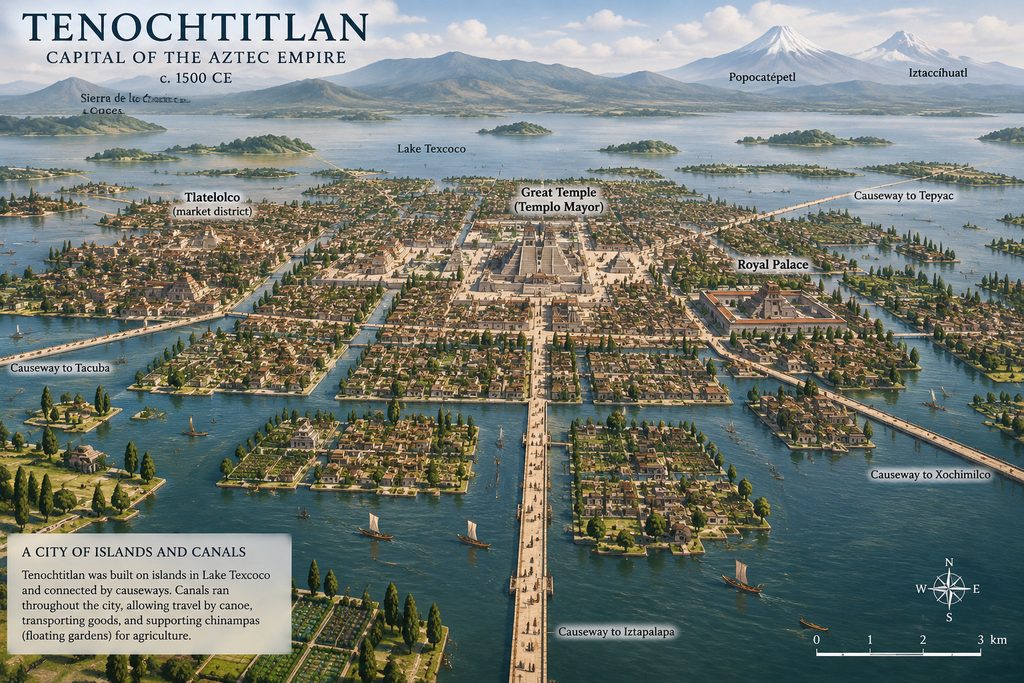
The ancient city of Tenochtitlan, upon whose location modern Mexico City developed, provides an especially interesting example. Tenochtitlan was the capital of the Mexica, commonly called the Aztecs. It was constructed on islands within Lake Texcoco and organized through streets, canals, causeways, and a central sacred precinct containing its principal temples.
Its urban plan was not inherited from Maya ancestors. Archaeological scholarship instead points to the influence of the much earlier central Mexican city of Teotihuacan upon Tenochtitlan’s ordered layout.
The monumental pyramids of ancient Mesoamerica present an entirely different architectural character from the Greek temple.
Their massive platforms, ascending levels, geometric forms, commanding scale, and orientation toward ceremonial centers give them a concentrated visual force. Within my personal Seven Rays interpretation, their strength, directness, monumentality, and upward movement suggest qualities of the First Ray—the Ray associated with Will and Power.
This is an esoteric interpretation rather than an archaeological classification.
Mesoamerican civilizations were complex societies encompassing religion, astronomy, agriculture, trade, warfare, artistic achievement, engineering, political organization, and ceremonial life. Human sacrifice and warfare formed part of some of these cultures, including the Mexica world, but it would be misleading to reduce an entire civilization or people to brutality.
Architecture reveals both humanity’s constructive and destructive capacities.
When one travels to ancient places, existing monuments sometimes seem to retain something of the consciousness that produced them. I experience this as a subtle energy emanating from form, place, history, and intention.
Within esoteric teachings, such sites may also be understood as retaining the energetic imprint of the Ray through which they were created. Some traditions describe Devas—intelligences associated with nature, form, and subtle energies—as participating in maintaining such places.
This belongs to a spiritual interpretation rather than to conventional architectural history, but it helps explain why certain locations can affect us so strongly.
People may be attracted to a place because its energy appears to supply something they lack. A particular landscape, temple, city, or work of architecture may stimulate qualities not sufficiently developed within the individual.
In other cases, attraction may occur because the individual already possesses a similar vibration and therefore experiences an immediate sense of recognition, comfort, or familiarity.
One kind of place may stimulate change; another may feel like returning home.
Energies can persist for thousands of years in places where civilizations have flourished. Whether we understand those energies spiritually, psychologically, historically, or as the accumulated power of human memory, ancient places continue to affect those who encounter them.
Other energies may remain preserved in distant and relatively untouched places of the world, awaiting another period in which their qualities can contribute to humanity’s evolution.
Architecture therefore represents far more than shelter or construction.
It embodies consciousness in form.
Through stone, proportion, geometry, rhythm, direction, material, and space, humanity leaves a record of what it valued, feared, worshiped, understood, and aspired to become.
Ancient architecture survives because form can outlive its creators.
And when we stand before those forms centuries or millennia later, something within us may still respond.
Originally written in response to the civil unrest of 2020; revised in 2026.
Anarchy, hatred, and divisiveness appear to be sweeping our country. Where or when will it end? Who or what is ultimately responsible for these events?
Author’s Note: In May 2020, the death of George Floyd while in Minneapolis police custody triggered an extraordinary wave of demonstrations across the United States. Derek Chauvin, the police officer who restrained Floyd for more than nine minutes, was later convicted of second-degree murder and pleaded guilty to federal civil-rights charges.
The demonstrations spread to thousands of communities in all fifty states. Most were peaceful, although some cities experienced serious rioting, looting, arson, vandalism, injuries, and destruction of businesses and property. Subsequent analysis found that approximately 94 percent of demonstrations associated with the Black Lives Matter movement involved no violence or destructive activity. In the minority of events in which violence occurred, responsibility varied and sometimes involved protesters, looters, counterprotesters, extremist groups, individual attackers, or confrontations with law enforcement.
The events of 2020 did not end America’s political turmoil. The attack on the United States Capitol on January 6, 2021, political threats against public officials, the attempted assassination of Donald Trump during the 2024 presidential campaign, and targeted attacks against elected officials in Minnesota in 2025 demonstrated that political violence cannot reasonably be assigned to only one political philosophy or one segment of society.
By 2025, Americans themselves overwhelmingly believed that politically motivated violence was increasing. At the same time, the overwhelming majority of public demonstrations continued to occur without violence. These two facts should remind us that protest and violence are not the same thing, and that disagreement does not have to become hatred.
You have summoned one of the deepest problems of the human condition.
Chaos often precedes calm. Ignorance is the antithesis of enlightenment. During critical events, human beings may reveal both their worst impulses and their highest capacity for harmless service. The division between constructive and destructive forces reminds us of the duality that struggles for resolution within humanity itself.
Our collective responsibility is not merely to defend our own interests, but to nurture, serve, and seek justice for our fellow human beings.
One should be concerned about injustice. But justice loses its meaning when compassion is extended only to those with whom we identify while the suffering of others is ignored. The death of one person through injustice deserves our concern. So do the innocent people whose businesses, homes, livelihoods, safety, or lives are destroyed in retaliation.
Compassion cannot be selective.
This does not mean that peaceful protest is lawlessness. The right to protest injustice is fundamental to a free society. Nor does concern for injustice justify looting, arson, assault, intimidation, or destruction. A society governed by law must be capable of recognizing both truths simultaneously.
The question therefore remains: Are we a nation governed by law and ethical responsibility, or will grievance increasingly excuse whatever conduct is committed in its name?
The seeds of agitation have existed throughout human history. Wars once provided the great outlet for collective hatred, anger, envy, domination, territorial ambition, religious fanaticism, and revenge. Today some of these same forces can appear within civilian society, amplified by political rhetoric, mass communication, social media, misinformation, and the extraordinary speed with which anger can be transmitted from one person to millions.
Civil conflict no longer necessarily requires two organized armies facing one another across a battlefield. It can arise when neighbors begin to view neighbors as enemies, when political affiliation becomes more important than human identity, and when disagreement becomes justification for contempt.
There are no simple lines dividing the righteous from the unrighteous.
In the spiritual terminology I use, Light and Darkness refer to states of consciousness—wisdom or ignorance, compassion or hatred, creation or destruction. They have nothing whatsoever to do with race, ethnicity, skin color, nationality, or political party.
The United States has not experienced a conventional Civil War within its borders since the nineteenth century, yet history throughout the world demonstrates what happens when political division becomes dehumanization. Civil conflict has produced genocide, assassination, starvation, forced migration, disease, ruined economies, devastated landscapes, and generations of trauma.
War destroys far more than armies.
It destroys homes, institutions, trust, cultural inheritance, natural resources, and the belief that one’s neighbor belongs to the same human family.
And yet there is an integrity within life. Humanity survives catastrophe. Nature regenerates after destruction. Individuals can learn after terrible mistakes. Even suffering may become a severe teacher when it awakens consciousness rather than producing further hatred.
The blame for social disorder cannot always be laid at the feet of one political leader, one political party, one movement, or one generation. Leaders certainly bear responsibility when they deliberately incite hatred, encourage violence, abuse their authority, or knowingly deceive the people they serve. But citizens also possess responsibility for what they accept, repeat, encourage, and eventually act upon.
Those who possess power have an especially great obligation.
Governments can manipulate.
Political movements can manipulate.
Corporations can manipulate.
Media can manipulate.
Social media can manipulate.
And individuals can willingly manipulate one another.
The means differ, but the underlying temptation is the same: to gain power by exploiting fear, resentment, anger, prejudice, or insecurity.
Modern technology has greatly increased this possibility. Opinion can be transmitted instantaneously, repeated endlessly, stripped of context, and directed toward audiences already inclined to believe it. People increasingly inhabit separate informational worlds in which each side can become convinced that the other represents an existential threat.
When people cease listening to one another, polarization becomes self-perpetuating.
Where there is power without accountability, abuse follows. Where there is grievance without responsibility, destruction follows. Neither principle belongs exclusively to the political Left or Right.
The COVID-19 pandemic further intensified many of the pressures already dividing society. It caused enormous loss of life, economic disruption, isolation, fear, disagreement over public policy, and mistrust of institutions. Worldwide, the World Health Organization estimated approximately 14.9 million excess deaths associated directly or indirectly with the pandemic during 2020 and 2021 alone.
When I originally wrote this article, I viewed the pandemic symbolically as an enforced period of cessation—a moment in which much of humanity was compelled to stop its ordinary movement and confront itself. I still believe that such a spiritual interpretation can have meaning, but it should not obscure the immense suffering the pandemic caused.
A spiritual interpretation is not the same as a scientific explanation.
The pandemic was not harmless. For millions of families, it brought death, grief, illness, isolation, economic hardship, and permanent change.
Yet human beings may still choose what they learn from suffering.
The deeper question is whether crisis increases consciousness or merely creates another opportunity for division.
Since 2020, the United States has continued to experience intense disagreement and enormous public demonstrations. In 2025, demonstration activity rose dramatically, reaching its highest level since 2020. Yet approximately 97 percent of demonstrations involved neither violence nor police intervention. This is important. Large numbers of people expressing disagreement do not constitute anarchy. Violence, intimidation, and the abandonment of lawful democratic processes are different matters.
At the same time, concern about politically motivated violence has become widespread. A 2025 national survey found that 85 percent of Americans believed such violence was increasing. Republicans and Democrats agreed on that point in almost identical proportions. Americans disagreed greatly about who was responsible, however—a revealing demonstration of the very polarization at issue.
Perhaps we spend too much time asking which side created the darkness and too little time asking what within human consciousness allows hatred to flourish.
The work of a relatively small portion of spiritually conscious humanity can still be great. Those individuals can help turn the tide away from selfish ambition, retaliation, fear, and domination.
We should therefore reflect upon the endless divisiveness produced when every event is immediately interpreted through political allegiance.
Justice without compassion becomes vengeance.
Authority without accountability becomes oppression.
Freedom without responsibility becomes disorder.
Conviction without humility becomes fanaticism.
And disagreement without recognition of our common humanity becomes hatred.
The remedy is not uniformity of thought. A free people must disagree. The remedy is the ability to disagree without destroying one another.
There must be room for protest and law, justice and restraint, freedom and responsibility, individual conscience and collective obligation.
The ultimate battle between Light and Darkness does not occur between political parties, races, religions, generations, or nations.
Anarchy, hatred, and divisiveness are sweeping our country. Where or when will it end? Who or what is ultimately responsible for these events?
(Author’s notes: 2020 Riots were engaged throughout all the major cities and went on for more than six days. Antifa and Black Lives Matter caused devastation to businesses following a reaction to the arrest and death of a man by abuse of police brutality.)
You have summoned the deepest secrets of the world. Chaos precedes calm. Ignorance is the antithesis of light. In these critical events, the world brings out the worst, yet a few men act with harmless service. The separation between good and evil reminds all of the duality that struggles for redemption in mankind. These cycles of disruption continue to challenge the ignorant, who are unaware that their collective responsibility is to nurture, serve, and bring parity to our fellowmen.
One should feel concerned about injustice. But injustice occurs when acting solely for one principle instead of another’s misfortune. Destructive forces that are allowed to act against only one view contravene the acts of compassion and positive forces of another. The destruction of property, loss of income, and even the consequent deaths and injuries were caused by a recent pandemic. The protesting public ignored these consequences, bringing suffering, misery, and pain to many more than the incident of one person.
Are we a nation of law or lawlessness? The reaction that predominated last week credited the protestors and sympathized with them while exonerating the lawless criminals who took advantage of the situation.
The seeds of agitation have been with the world since its beginning. Wars were the outlet for shedding blood (the root of blood is the emotions of hatred, anger, envy, domination, etc.) Civil war has taken on a new identity, particularly among the younger generation, which seeks retribution through old forms of destruction, domination, and uprising. There are no clear lines of demarcation between the Sons of Light and the Sons of Darkness. The armies of nations are absent, and the discontented people at war with the government remain hidden beside their civil neighbors. They are legion in number and await their dark leader to come forward with the full fury of civil unrest and militant confrontation. Beware— the next few generations bear the seeds of civil strife.
The United States has not endured a Civil War within its borders since the 1860s. In other histories, civil unrest is common across the globe, with genocide, murders, assassinations, hunger, depravity, disease, and forced relocation to its civilian population. Wars erase population, increase the coffers of a few political leaders, destroy property, and devastate natural resources. Despite the intended ruination of resources and the marring of nature’s beauty with fire and pestilence, our Earth Teachers cannot be destroyed. There is ”integrity in life,” whether we speak of mankind or the earth kingdoms that survive conquest. The evil-doers of the black path try to conquer, but they cannot. They bring fear, loss, and suffering, but these become the tools of learning.
The blame falls upon each entity whose heart has been blackened by hatred. It does not repose on any one political leader’s feet unless that leader has consciously caused war against his people. An example is powerful chieftains inciting their people to act against one another. More advanced technological countries are less conspicuous in their covert designs to dominate weaker minds with opinions meant to subvert and divide political lines. They inspire men to fight. These men use the tools of media and big-business policy as enforcement mechanisms, as vehicles for polarization. Many in positions of power use their influence over others. Until all sides drop barriers of divisiveness that drive power and control, there will be disobedience from the bottom up. Where there is no accountability, abuse of power remains.
The seeds of agitation grow each day despite the economic progress and technical and social advances made in the last decade. When national discontent turned to political sabotage that threatened the values of American life, a pandemic was sent. The COVID-19 virus (symbolized by the bat and its association with darkness) allowed the natural grievances of nations’ political parties and financial giants to create havoc in the American sphere and the global economy. The intent to cause harm allowed circumstances to occur. Blame cannot rest on any ONE shoulder. The dark forces of evil wait for every opportunity to instill unrest. If everyone could only see the collective anxieties prevailing over goodwill, trust, and decency, the world would suddenly appear in a very different light.
The work of a small percentage of humanity is great, and we call upon those to turn the tide of selfish ambition. Reflect upon the endless divisiveness caused by the opinion-makers who make faulty interpretations of every policy.
The pandemic is a sober but harmless solution relative to the numbers lost to wars and natural disasters. It is effective as a tool for self-reflection, rest, and cessation of movement.
Since the late 1940s, the subject of unidentified flying objects and possible extraterrestrial life has moved from widespread skepticism and popular speculation into serious public, scientific, military, and governmental discussion. The terminology itself has changed. What were once generally called UFOs are now often referred to officially as UAP—unidentified anomalous phenomena.
Public interest has not disappeared. In an August 2026 Gallup survey, 37 percent of Americans said they believed that at least some UFO sightings have been alien spacecraft visiting Earth, while 49 percent believed the sightings could be explained by human activity or natural phenomena.
The subject has also entered official government inquiry to a degree that would have seemed remarkable when I first wrote this article. The Department of Defense established the All-domain Anomaly Resolution Office (AARO) to collect and investigate UAP reports, and Congress has held public hearings in which military personnel, former government officials, and other witnesses have testified about unexplained observations and alleged government programs. NASA has also undertaken a scientific study of UAP.
This increasing official attention does not mean that extraterrestrial visitation has been proven. AARO and NASA state that they have found no verified evidence that UAP represent extraterrestrial beings or technology. Many reported cases have ultimately been identified as balloons, aircraft, satellites, drones, birds, or other ordinary phenomena. Other cases remain unresolved, sometimes because the available visual or sensor data are simply inadequate to determine what was observed.
That uncertainty is important. Unidentified does not necessarily mean extraterrestrial. But neither does the inability to identify an object answer every question surrounding it.
For decades, the movie industry has perpetuated the fear that aliens might invade or destroy our planet. Humanity’s own history has supplied ample material for such stories. Earth has evolved through endless battles, conquests, invasions, and struggles between opposing forces. Religion and mythology have also portrayed the battle between good and evil. It is perhaps inevitable that, once humanity began seriously contemplating life beyond Earth, this ancient drama would be projected beyond our planet and into the stars.
At the same time, increasing numbers of people have publicly described experiences that they interpret as encounters with nonhuman beings. Some have undergone hypnosis or regression in attempts to recover memories associated with these experiences. Such accounts can be intensely meaningful to those who experience them, but regression cannot by itself establish that an event occurred exactly as remembered. Modern research has shown that hypnosis and suggestion can sometimes contribute to the formation of false or altered memories.
Stories of beings associated with Alpha Draconis, Orion, Reticulum, Sirius, and other star systems have become part of UFO and metaphysical literature. We hear of reptilian beings, the Grays, hostile extraterrestrials, and, at the opposite extreme, benevolent star beings believed to watch over or guide humanity. These descriptions belong primarily to personal testimony, UFO lore, and esoteric traditions; they have not been scientifically established.
Nevertheless, whenever I hear such stories, I feel uneasy. It is as though I have touched something “alien” in itself—something foreign to ordinary consciousness and perhaps counterproductive to our evolution in this system.
In this vast universe of billions of galaxies, I find it difficult to believe that consciousness exists only upon Earth. That is my personal conviction, not a scientific conclusion. Science continues its search for life elsewhere, and discoveries of thousands of planets beyond our solar system have greatly expanded our awareness of the possibilities. Whether intelligent extraterrestrial civilizations exist, whether they are aware of Earth, and whether any have actually visited us remain separate and unanswered questions.
Perhaps the alien has another significance as well.
Humanity has always feared the unknown. Throughout history, encounters between unfamiliar peoples and cultures have often produced suspicion, conflict, conquest, and fear. Human beings have inflicted nearly every imaginable horror upon one another. Nazi Germany remains one of the most terrible modern examples of organized domination and extermination, and such events remain embedded in humanity’s collective memory.
We therefore understand the fear of conquest because we ourselves have practiced conquest. We understand domination because humans have dominated other humans. We fear enslavement, extermination, loss of freedom, and control by powerful forces because all of these already belong to human history.
It is not surprising, then, that we project these same possibilities upon beings from other worlds. Aliens become conquerors, destroyers, experimenters, slave masters, or secret manipulators. The very word alien means foreign, strange, or belonging elsewhere and thus provides a clue to the psychological power of the idea.
In this sense, the alien may function almost as an archetype within the collective unconscious. It embodies that which is unknown, foreign, powerful, and beyond our control.
Fear is closely connected to the personality and its instinct for survival. The modern alien scenario may not be entirely different from the fears experienced by earlier peoples confronted by something outside the boundaries of their known world. The drama of alien encounters heightens the emotions and feeds the imagination.
Whether or not a particular alien scenario is physically real, fear itself is real in its effects upon consciousness. What we continually fear and emotionally energize can acquire tremendous psychological power. From an esoteric perspective, thought itself is creative, and collective thought may exert an influence greater than we ordinarily recognize.
This brings me to another aspect of the subject: entities.
Within many spiritual and esoteric traditions, entities are described as forms of consciousness existing outside ordinary physical perception. Some teachings describe thought forms that become strengthened or “vivified” by repeated thought and emotional energy. Others describe discarnate beings or psychic influences capable of attaching themselves to vulnerable individuals. These concepts belong to metaphysical traditions and should not be confused with scientifically demonstrated phenomena.
To me, however, their symbolic and spiritual significance remains important.
The archetype underlying the threatening alien resembles the ancient image of the dark force—the unknown power that challenges consciousness. In many respects, the inner forces of fear, hatred, obsession, domination, addiction, and destructive thought may pose a greater immediate danger to human evolution than any hypothetical visitor from another planet.
The struggle between Light and Darkness can therefore be understood as the struggle between spiritual enlightenment and the lower, instinctual aspects of human nature. Spiritual enlightenment involves the gradual refinement of the personality through self-knowledge, ethical living, meditation, compassion, wisdom, and purity of intention.
When harmony is achieved between the heart and the mind—between the feeling nature, intuition, and wisdom—fear begins to lose its power. The unknown does not automatically have to become the enemy.
Aliens and entities may continue to perplex us because they represent everything lying beyond our familiar boundaries. They may be physical, psychological, symbolic, spiritual—or, perhaps, phenomena belonging to categories we do not yet understand.
It may therefore be a mistake to divide the universe too easily into monsters and saviors, evil extraterrestrials and benevolent guardians. If other intelligent beings exist, they too may represent a vast range of consciousness and development, just as humanity does.
My earlier thought that humanity must somehow defeat or annihilate threatening alien forces now seems less important to me than another possibility: that humanity must overcome the fear within itself.
The true spiritual victory is not the destruction of an alien enemy. It is the transformation of consciousness.
Darkness—whether we interpret it as ignorance, fear, hatred, destructive thought, or negative spiritual influence—cannot flourish where genuine love, wisdom, discernment, and clarity prevail. Those who are troubled by fear can turn inward through meditation and seek contact with what they understand as the higher self.
Our hope lies in the broadcasting of radiant thought and consciousness throughout our world and, perhaps, throughout the greater circumference of space.
If unknown beings coexist somewhere within our planetary spheres or cosmic corridors, they too may be evolving and aspiring beings. Consciousness may exist across a range far greater than we now comprehend—from forms dominated by instinct and fear to intelligences of extraordinary wisdom and compassion, perhaps approaching what humanity has traditionally understood as the angelic.
We do not yet know.
And perhaps that is the most important change in our understanding of the alien question. We have moved from ridicule to investigation, but not from mystery to certainty.
The universe remains immense, consciousness remains mysterious, and the unknown remains before us.
Our task is to approach it with discernment rather than fear.